“Though nothing can bring back the hour of splendor in the grass, glory in the flower.”
William Wordsworth
Sometimes we come face to face with our mortality. That all things will end. That the page must be turned. That the chapter ends. And that the sports trophies must go. Children who’ve long relinquished a claim to the bedrooms of their youth have made a life for themselves, and, at a minimum have created new bedrooms in their adult image. No more tiki hut and artist’s studio and posters for The Matrix and Lord of the Rings.
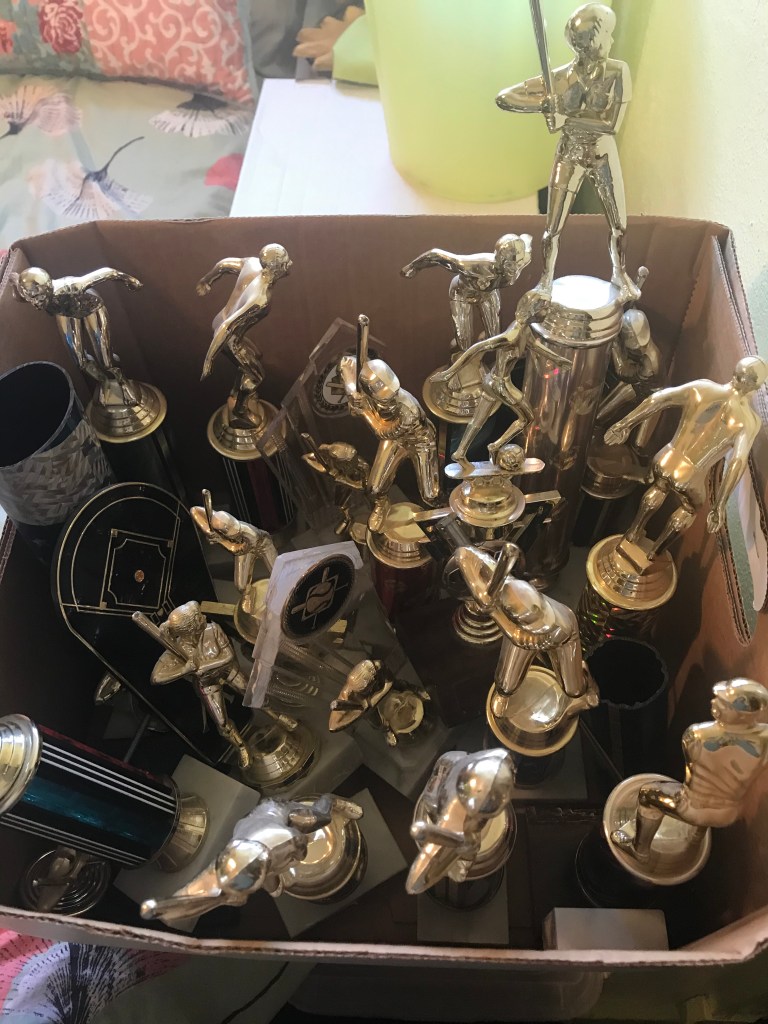
What remains behind are the plaques, the ribbons … the trophies. The trophies, dusty, tarnished, proclaiming mostly insignificant events, not even victories in most cases, but merely the fact of showing up for practice and contests – in the spring from March – June, but also in the fall season, August – November. Of course, when I think about it, summer swim team runs from May – July. I suppose, parents with children in ice hockey and basketball have to deal with a November – March season. And it’s my impression that soccer is ALL year long.
Trophies displayed on the shelf have too much of a physical presence, requiring a footprint that I’m now unwilling to grant. And yet they remain as an affirmation of a parental commitment to get a child to practice and to the game on time. What I call that portion of child-rearing, the child-relocation business.
Trophies call up memories of the tight turnaround met between the end of the school day and the practice time on the other side of the county. What mother hasn’t pushed the edge of the speeding envelope so that her child wouldn’t have to run laps as punishment for a late arrival. (A Novel Idea: Why punish the kid? Make the Moms/Dads do the laps.)
Trophies represent memories in some cases of games won and lost, but more than not, the moments that one’s child overcame deficits of height or speed, or fell short in skill and power. My breath gets short, my heart flutters, when I suddenly call up a moment of disaster and disappointment that my child felt and endured. A terrible moment of pain that I felt equally, a moment that I had no power to contain, fix, ameliorate, deny, or, just plain, make vanish.
Everyone who even contemplates parenting a child should get some kind of training in learning to deal with failure. Why didn’t we learn that lesson when we were young? It’s easy to say, ah me, I wasn’t an athlete so how would I get this lesson.
Authorial aside: A wicked little voice whispers, yeah sure. You had this lesson, it just didn’t stick. Remember when you were a nerd before nerds were cool? Remember the science club election? You lost the presidency to the popular kid who hardly attended meetings? Your boyfriend had to drive you all the way out to Fairview while you screamed out your rage in hot tears at the injustice, the unfairness, the denial of your dream. No matter that the dream was born of a hubris that would make the gods blush – that achievement was supposed to be yours. The loss cast a pall over the remainder of your high school career. Nothing else could erase your anger at being thwarted in your goal. And you never got over it. The sting didn’t subside into an annoying pang until…when? Forty years after?
Winning is so easy – we smile, we laugh, we cheer, we rejoice, we get ice cream, we get pizza, we go to Disney World. But what to do when we fall short. How do we help our child when they fall short? How do we deal with the anger, the tears, the sullen silence, the staring out the car window? Our hearts are breaking and the soft cocoon we’ve tried to form around our nascent butterfly has been breached.
What we do, unfortunately, is we try to make winning less important. We try to make the fact that you showed up with perfect attendance be the standard. And we give everyone a trophy. And aside from the fact that these items collect dust, is this such a good idea?
Let’s face it – the trophies are for parents. For that perfect photo op. For the moment when your child is a winner. Once children figure out that everyone is getting a trophy and that this is the norm and not the exception, the trophy becomes devalued in their eyes. For this to be a coveted treasure it must be a unique, special, and discrete representation of the moment. Which it is not.
And now, years later, the evidence that Mom and Dad did their utmost to give their child a well-rounded experiential youth must be dealt with because these dust-gatherers are living rent free in spaces that would be better used to display the Central American pottery collection.
So, sadly I pulled them off the shelves and examined each of them and remembered afternoons when the sun was falling at just that level on the horizon to trigger a migraine as I was driving toward the west to get someone to softball practice. Recalled the discovery of a fortuitous shortcut that shaved minutes off the trip to gymnastics. Smiled with pride thinking of the reception of brownies baked to feed the swimmers in the car after practice. And, in a self-congratulatory, valedictory farewell thought of all the hours spent watching, cheering, and managing the t-ball and softball teams.
These are my trophies too.
To actually decommission these objects, I carefully pried the nameplates off with a steak knife, only once stabbing my hand in the process. The nameplates now nestle in the photo album next to that year’s team sports photo. Two trophies were special enough that I determined a way to downsize them by removing the ostentatious center support and reattaching the figure at the top to the marble base, but those were unique and special, as they should be.
The plaques are another matter. Plaques apparently are the unique, special, and discrete representation of a glorious moment in time which doesn’t occur until high school and beyond. Plaques will be relegated to a box someday, but they may never be relinquished to the ash heap of history. That Sportswoman of the Year plaque? That Louis B. Armstrong Jazz Band Performer of the Year plaque? Those were triumphs of skill, perseverance, practice, and will.
Those achievements are theirs alone.
“We will grieve not, rather find strength in what remains behind.”
William Wordsworth

 Forced Perspective