Nationals Park, October 1, 2019 (photo of tv screen)
March – Bryce Harper. Yeah, you loved DC until you didn’t. But the PHILLIES?! Of all the places to go. So just go.
April – Eagerly hopeful. This is the year, right? Pressed my psychic energy into helping the team.
May – Hated baseball. Despair sets in. (SIL reminded me everyday – long season, 162 games, pace yourself)
June – Began to be hopeful. But cautious hopeful.
July – Looked like team was on a roll, but dreading the after-All-Star-Break slump.
August – Whoa. This Is The Team!
September 3 — Ryan Zimmerman quote of the season: “I blacked out and then we won.” No, seriously. Bottom of the ninth, Nats down 10-4. Come back with 7 runs and a Suzuki walk-off homer. Can’t make this stuff up.
September – THIS IS THE TEAM.
Late-September – Is this a slump? Oh shit.
Last eight games – What a streak! Swept the Phillies! (Thanks, Bryce – you said you wanted to bring a championship back to DC!) And then the Indians! Bring on October!
Wild Card Game – Soto! SOTO! THIS IS THE TEAM!!! Hug all the folks sitting near me! High five everyone. New friends from Seattle whose names I don’t know.
NLDS Game 1 – Reality sets in
NLDS Game 2 – This Is The Team
NLDS Game 3 – Contemplating seppuku
NLDS Game 4 – oh man oh man oh man! Not Really!!!!!
NLDS Game 5 – Howie! Howie! Howie! WE’RE GOING TO THE NLCS!
NLCS Game 1 – OK, now just remember, this is the Cardinals, this won’t be easy like the Dod- what? we won?!
NLCS Game 2 – We won?!!
NLCS Game 3 – WE WON?!!
NLCS Game 4 – OK, now just remember, this is the Car- HOWIE!!!! We’re going to the WORLD SERIES!! OMG OMG OMG – WE SWEPT THE CARDINALS!!
Here endeth the diary. Couldn’t get past sweeping the Cardinals in the NLCS. Still don’t believe it.
The Washington Nationals won the World Series. Turns out the Astros were cheating at least some of the time. Thanks of a grateful nation for not letting them cheat their way to another win.
We swept the Cardinals in the NLCS. Still can’t believe it. Sleeping in NLCS Championship t-shirt ALL the time.
Anyway, Spring Training 2020 is just around the corner. Here we go again.
Addenda in case you forgot:
On May 23 the Nats posted the worst start since 2009 – 19-31. Really not surprising since 5 starters missed more than 75 games between May 7 and May 29.
To wit:
Trea Turner, broken right index finger – missed 38 games – returned May 17
Ryan Zimmerman’s plantar fasciitis resurfaced in his right foot – missed 17 games – returned May 17
Juan Soto – back spasms – missed 10 games – returned May 11
Anthony Rendon – left elbow contusion – missed 9 games – returned May 7
Anibal Sanchez – left hamstring on May 17, returned May 29 and then won 8 straight.
And then: Scherzer broke his nose during batting practice, pitched looking like absolute hell on June 19 and added to his legend. Was on a roll but spent half of July on the IL with back strain, not to mention the 11th hour insanity of games 5, 6, and 7 of the World Series.
The bullpen was never even close to “right” until Daniel Hudson arrived on July 31. And then Sean Doolittle goes on the IL on August 17 with right knee tendinitis, but finally returned to form on September 25.
Manager Davy Martinez has to go to the hospital during the 5th inning on September 15 with something not quite a heart attack. Has to have a stent installed for pete’s sake. Missed three games.
Nats finished the season 93-69. And I lived to tell the tale.
Please note: Since this film has been in release for some weeks, I feel comfortable discussing all aspects of it – beginning, middle, and end. In other words, you might want to avoid reading this if you don’t want the movie spoiled for you. Also, I normally provide hyperlinks for any book or film production or television show mentioned in a post. As you’ll see, there are too many to link. I’m sorry, but you’ll just have to look them up with IMDB or Wikipedia.
This is not a review. If it were, I would exhaustively examine every aspect of this film which I think is exceptionally well made in all technical aspects. And I totally understand a filmmaker’s desire to leave their individual stamp on the remake of a film, especially one with so many versions. BUT… one should know that when touching a property woven deeply into the cultural fabric, one should tread lightly and carefully. Greta Gerwig in her desire to make this property hers and infuse it with a modern feminism did not tread lightly.
Please know that I’m not criticizing the feminist rants sprinkled throughout. Those are fine. Little Women has always been subversively feminist. At some point in growing up, what girl doesn’t identify with smart, awkward, blunt Jo? The strictures placed on anyone without their own money and enough of it to live comfortably, albeit modestly, are maddeningly difficult. The book describes, harshly in some cases, almost every career available to a respectable woman in the mid-nineteenth century. Little Women, simply by illustrating the plain lives of the March sisters and their humble ambitions, is a treatise on the condition of early 19th century women and we feel deeply the societal restraints placed on them.
The characterizations and the casting of the protagonist daughters are spot on. These actresses imbue the roles with humanity and embody each sister with her unique character. They have already made their mark in films. Emma Watson, the erstwhile Hermione Granger from the Harry Potter films, plays Meg. Saiorse Ronan, most recently seen in Gerwig’s Lady Bird, and as Mary, Queen of Scots with Margot Robey’s Elizabeth I, plays Jo. Midsommar‘s Florence Pugh is stunning as Amy; and Eliza Scanlen, recently seen in HBO’s Sharp Objects and the least well-known, is Beth.
The production values are exquisite. A scene at the seashore is reminiscent of impressionist paintings. I can find no fault with the costume or art direction, both are meticulous in their detail. It is lovely in every respect.
My irritation is founded in Gerwig’s rearranging of the story. She begins at the two-thirds mark in the book with Jo located in New York. Steadily, she literally flips back and forth in the pivotal scenes to tell the story of the March sisters. Any viewer who has never read the book will be totally lost. Really lost. When I realized how the story was being revealed I gave up on my spouse ever achieving understanding of its importance. And after all, as a man who grew up from boyhood, when would he have ever met Meg, Jo, Beth, and Amy? (Please don’t send me notes describing how your husband / boyfriend / brother et al. has read and enjoyed the book. It’s the original “chick lit.” If he did, which March sister did he identify with? Don’t say Mr. Brook, Laurie, Mr. Laurence, Professor Bhaer, or Mr. March. This isn’t their story. They’re supporting personnel only.)
As tiresome as it may be to observe this, sometimes the way a story is told is important. It’s important to see the sisters grow up together, endure their trials together, learn to become decent adult citizens together, share their joys together. There are lessons here and they bear repeating over and over because they reflect the human condition in full. To alternate between tween years and young adulthood, and flip back and forth in the tale, diminishes the understanding of the journey to maturity of the sisters.
Additionally, this leads to puzzling moments: Aunt March sighs over Meg’s marriage to penniless Mr. Brook, and lectures Jo and then Amy on the importance of making a good marriage, but also on having one’s own money. As she belabors this point, one starts to wonder how she came by her own money in the 1800s, but it’s clearly inherited. She’s obviously wealthy and she’s never been married. At Meg’s wedding she’s referred to as Mr. March’s sister, a departure from the book. If Gerwig had thought for just a minute she would have wondered why would Aunt March be wealthy and not Mr. March? If she’s his unmarried sister, she would be under his protection according to 19th century custom and inheritance practices. This may seem like a small thing in the story, but this is the kind of mixed up detail that distracts from the film and makes me throw up my hands in irritation.
Further on, nothing in the story gives any explanation whatsoever for why Jo would develop feelings for Professor Bhaer. She just suddenly realizes he’s the one for her with no exposition of their friendship as offered — slight as it may be — in the book. And why is that? Because, at the end of the film, it is at last revealed that this is the story of Louisa May Alcott and how she became a published successful writer and not really the story of the March sisters. Gerwig has lured us to the theater under false pretenses. I would have been fine with a film about Louisa May Alcott and would have been fine with scenes from Little Women being woven into her story. But to promise me Little Women and give me something less (not much less, but really, insert eyeroll here) was irritating.
Meg, Jo, Beth, and Amy serve as a kind of Myers-Briggs for girls and women. We all see ourselves in the various aspects of the March sisters. We identify with their sins: Meg’s envy of her society friends, Jo’s brash rudeness, Beth’s shy and quiet ways that border on fearful, Amy’s self-centered selfishness. We know these girls. We are them and they are us and we will always care for their story. Because when they triumph over adversity, over circumstance, over themselves, so do we. We remember those glorious moments when we became who we were meant to be.
And when their story is not told well or mishandled, it cheats us all of the meaning and charm of their lives.
____________________________
Below is a list (by no means complete) of notable versions of this timeless story:
1933 – The legendary Katharine Hepburn as Jo. Spring Byington as Marmee — a noted character actress who later starred as Penny Sycamore in You Can’t Take It With You and in the TV show Laramie. The 1933 version is cited by many as their favorite, but it can only be because of Katharine Hepburn. A curious note for film afficionadoes and trivia mavens: Katharine Hepburn and Saiorse Ronan not only share the role of Jo March, but also that of Mary, Queen of Scots.
Little Women (1949) MGM
1949 – June Allyson (The Stratton Story) as Jo, Peter Lawford (A “Rat-Packer” and President Kennedy’s brother-in-law) as Laurie, an OMG -blonde Elizabeth Taylor (Who’s Afraid of Virginia Woolf?) as Amy, Margaret O’Brien (Meet Me in St. Louis) as Beth, Janet Leigh (Psycho) as Meg, Rossano Brazzi (Three Coins in the Fountain) as Professor Bhaer, Mary Astor (The Maltese Falcon) as Marmee. Allyson and O’Brien were noted for their great crying ability.
1978 (television) – Susan Dey (The Partridge Family) as Jo, Meredith Baxter Birney (Bridget Loves Bernie and Family Ties) as Meg, Eve Plumb (The Brady Bunch) as Beth, and Ann Dusenberry as Amy, and William Shatner (Star Trek‘s James T. Kirk) is Professor Bhaer. Shatner and Dey were a pleasure to watch in those roles. This television version may not be high art, but it’s better than lame iterations that try to modernize the story not to mention the several lifeless BBC productions. (What is the BBC doing making versions of Little Women? Do Americans remake Pride and Prejudice? Come on, people – know your place.)
Little Women (1994) Columbia Pictures
1994 – Winona Ryder (Stranger Things) as Jo, Christian Bale (Batman Returns) as Laurie, Kirsten Dunst (The Beguiled) as Amy, Susan Sarandon (Dead Man Walking) as Marmee, Gabriel Byrne (The Usual Suspects) as Friedrich Bhaer, and Claire Danes (Homeland) as Beth. Directed by Gillian Armstrong. This is a darling, warmhearted version, beautifully filmed with four young actresses who have lived up to the promise shown in this film. Sarandon’s Marmee was the beginning of highlighting the feminism in the story.
So life has been really intense lately. I mean INTENSE. And that happens. Ferris Bueller said it best: “Life moves pretty fast. If you don’t stop and look around once in a while, you could miss it.”
So I’m trying to calm down and look around. (And by the way did you get your flu shot? You know who you are so go get it NOW.) In the meantime, I have the cure-all of cure-alls for any winter sniffles. This has chicken broth, vitamin A, ginger, garlic, coconut milk, no processed sugar – really this will cure anything and everything from a cold to a vampire infestation.
Soup, after all, is warm, comforting, and delicious. And this soup is all that and a bag of chips.
Butternut Squash Soup
Spread 3-4 lbs. of cut up butternut squash on foil covered baking sheet.
(Cautionary preparation note: I always buy my butternut squash pre-cut at the grocery store. A whole butternut squash is hard and tough and will fight you all the way through the cutting, peeling, scooping of seeds, and chopping process. If you must use an entire butternut squash, bake it first and then scoop out the seeds, toss those, and then scoop out the flesh. You will probably need two squash to get the 4-5 cups required. But really…trying to cut it up yourself, you could lose a finger or pierce an artery. It’s just not worth it.)
Spray the sheet beforehand with olive oil. Or sprinkle with olive oil just enough to keep the squash from sticking. Sprinkle with cinnamon and nutmeg. Roast at 400-425 degrees, 40-50 minutes. Less time will be needed if the pieces are an inch or less in size. Keep an eye on the roasting and stir once in awhile. The sugars in the squash will caramelize, but don’t let the ends get too dark.
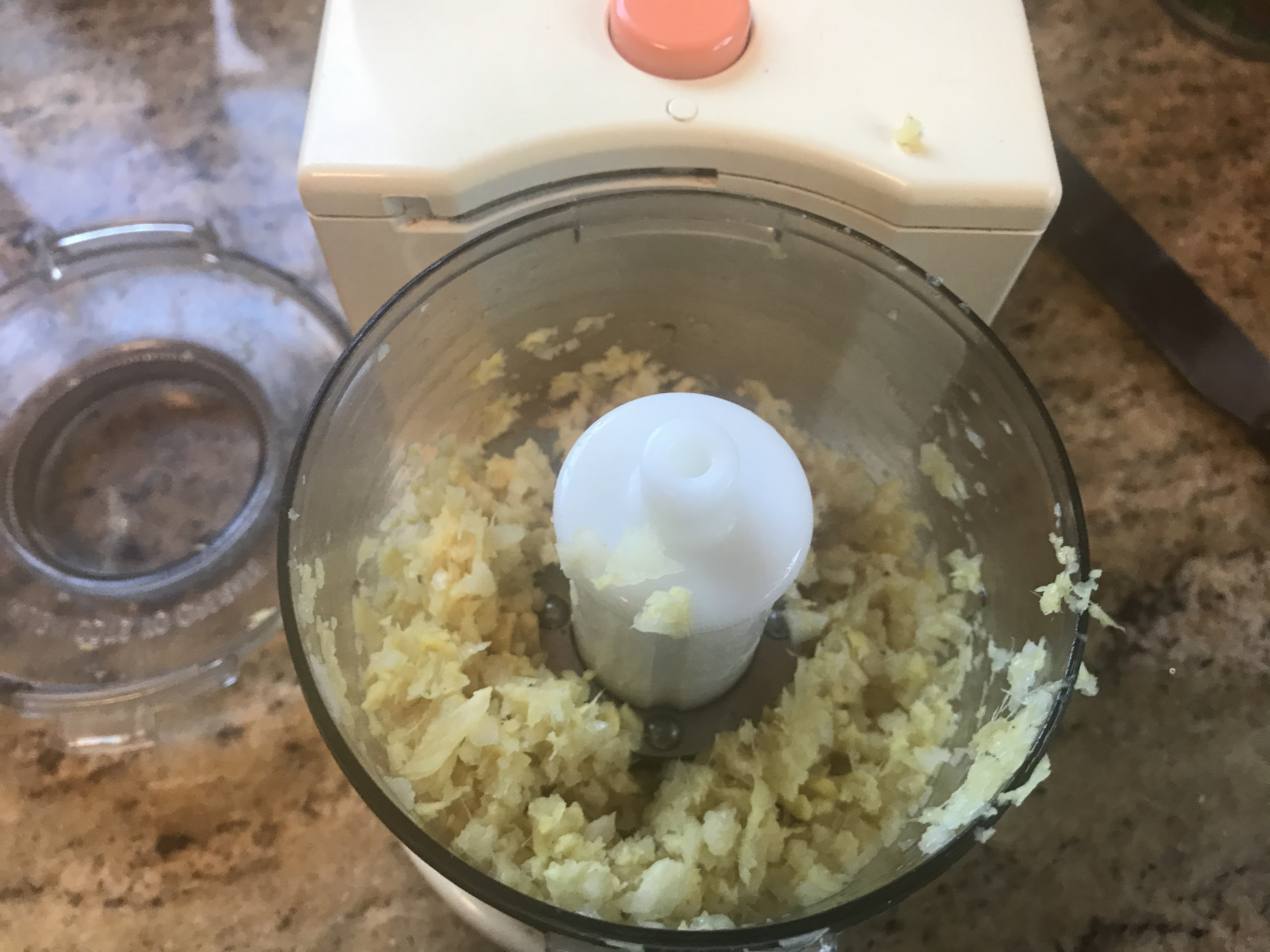
Chop the following in a small food processor, very fine:
1-2 inches fresh ginger, peeled (more if you really, really like ginger) 5-10 garlic cloves (never enough)
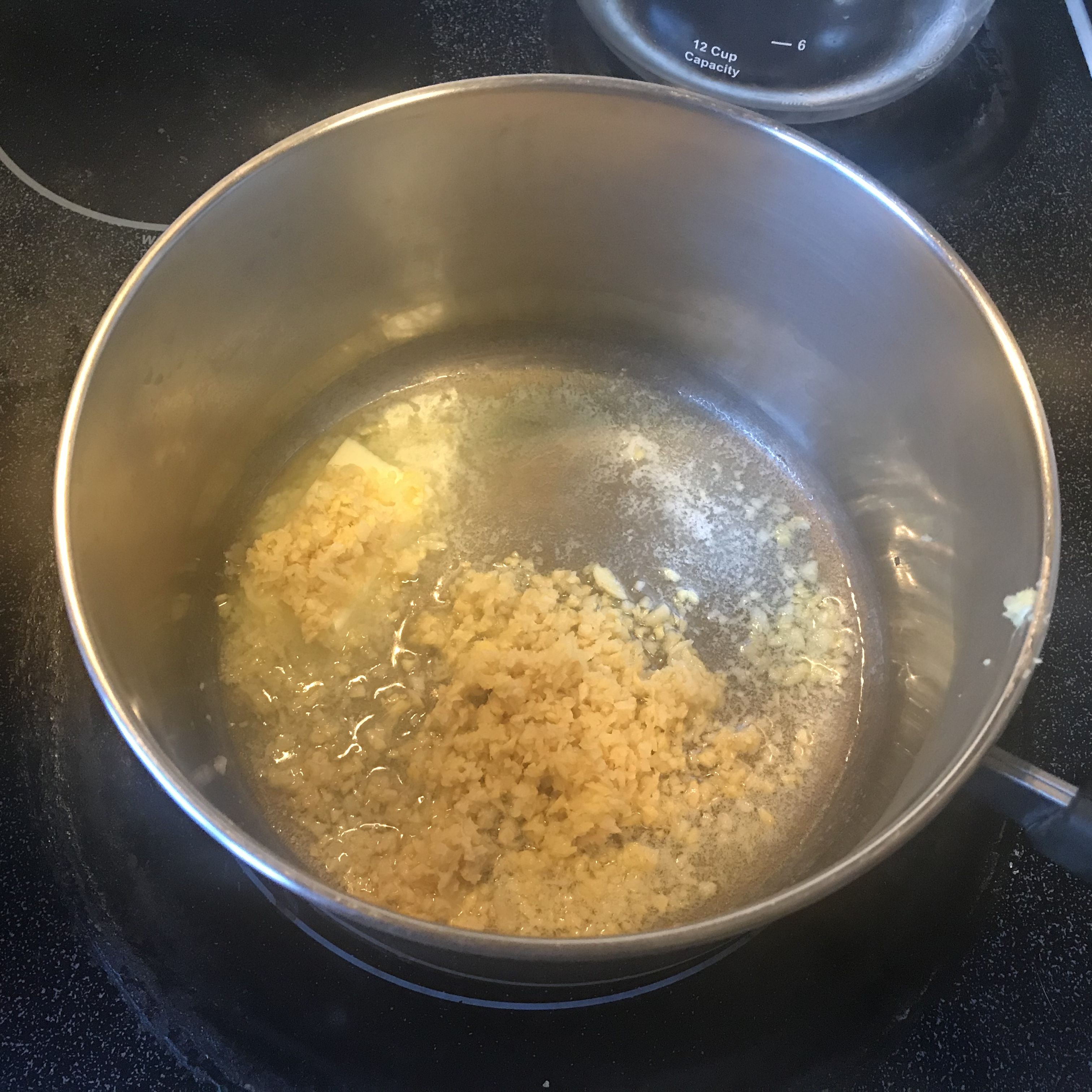
Heat in a large pot (4 qts) ¼ cup of one of the following: Butter or olive oil or bacon grease (I prefer butter, but I would eat butter by the spoonful if allowed, so consider that.)
Sauté the ginger and garlic till soft and fragrant, about 5 minutes. Don’t burn, otherwise you’ll have to toss it and start over. Seriously – it’s not worth it to spoil this with burned garlic.
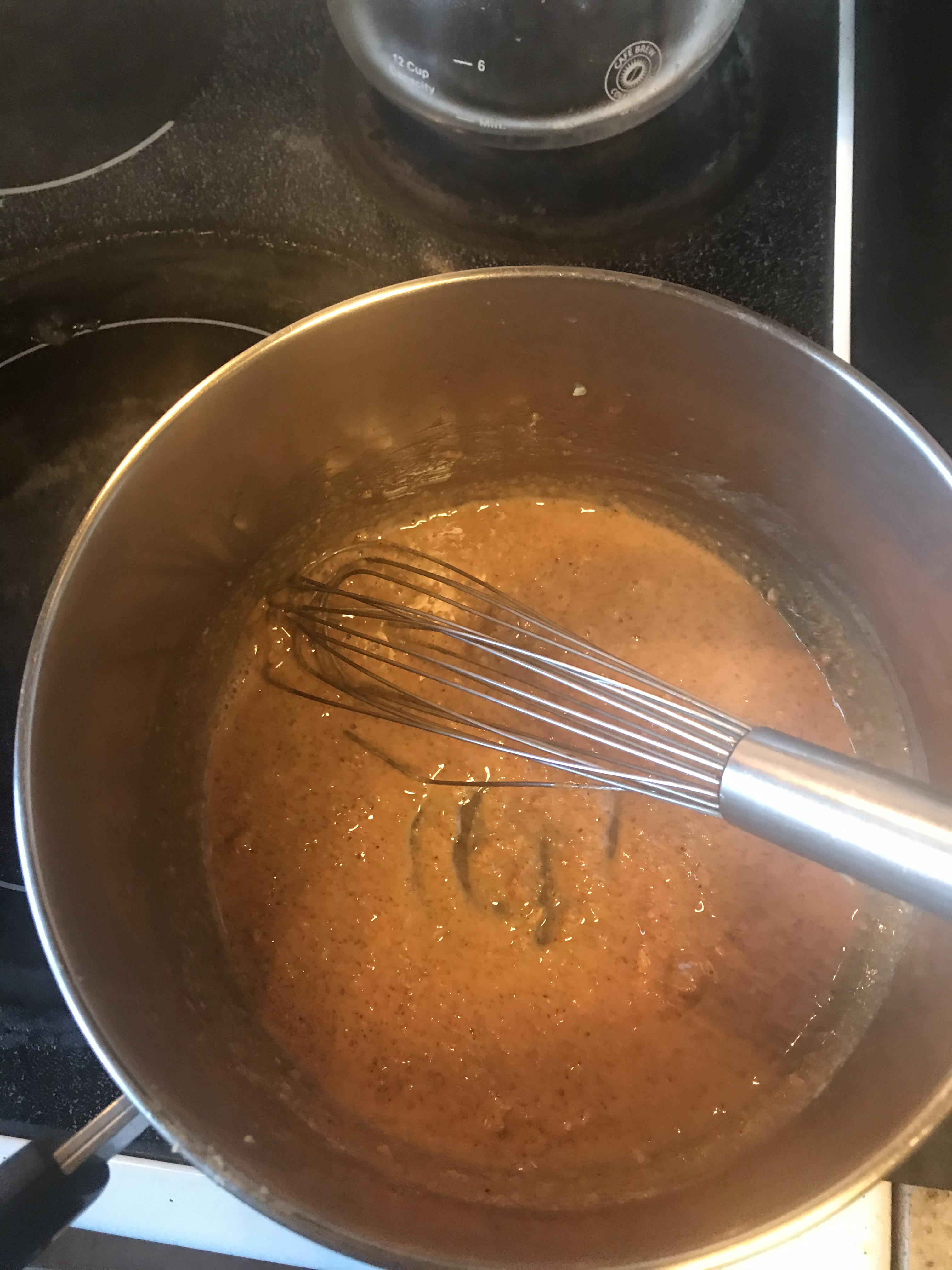
Whisk in ¼ cup almond butter until melted and smooth with the garlic-ginger sauté. Dump in: 4-5 cups cooked butternut squash 1 can coconut milk 1-2 cans chicken broth
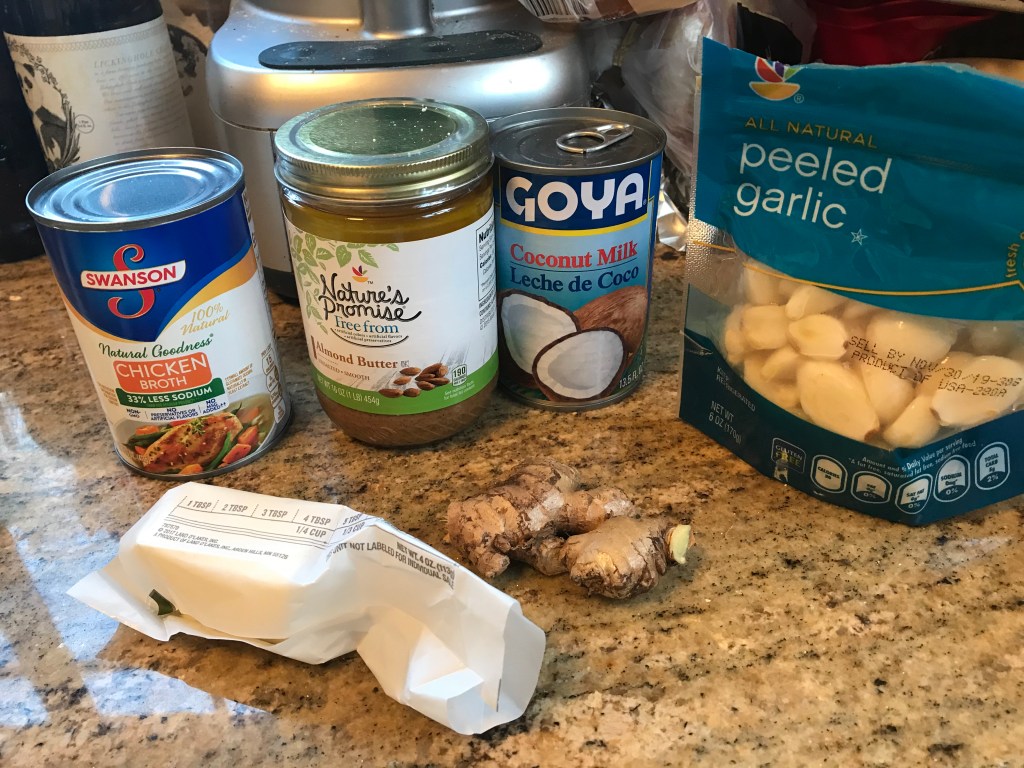
Some of my preferred ingredients
The amount of broth you pour in is flexible. If you barely have 4 cups of squash, then 1 can of broth may be enough. If you have a solid 5 cups of squash that you had to mash down to fit in your 4 cup measuring cup and don’t want your soup to be a pudding-like consistency, please add the second can.
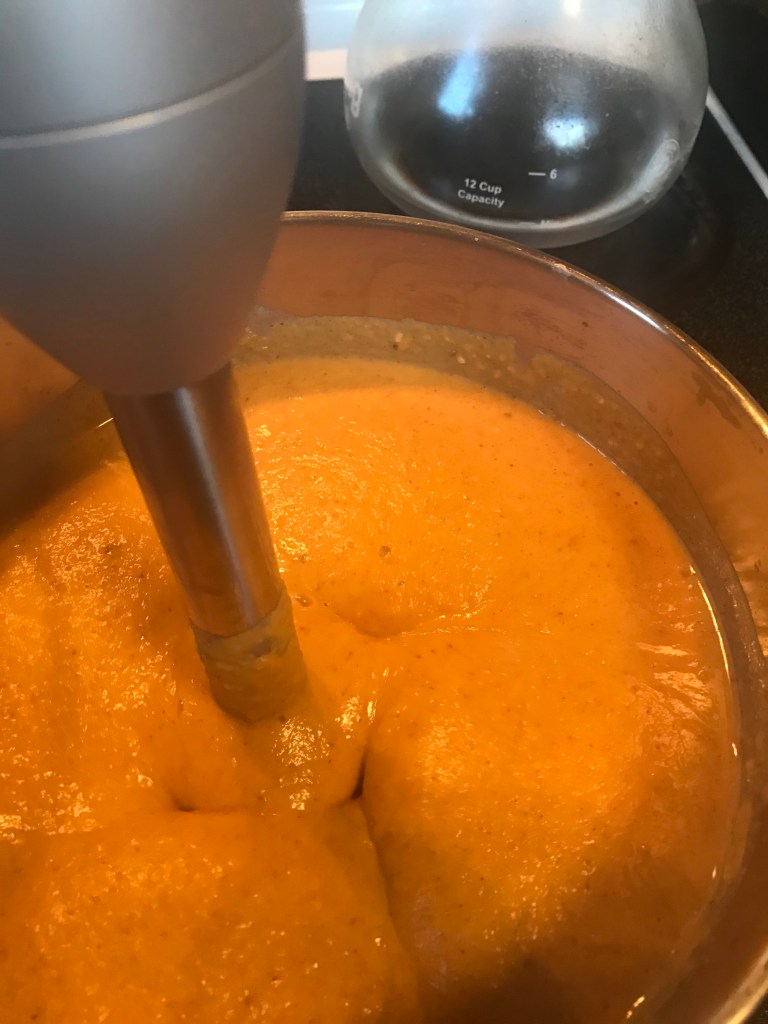
Stir together but at this point you’re really ready for the immersion blender. Like this one. Be sure you position the cord so it doesn’t cross the burner on the stove. You might want to remove from the burner to a safer location, blend it until smooth, and then return to the heat.
Let me say this about my direction to blend until smooth. If it’s not smooth, put the immersion blender back in and blend until it’s completely smooth and there are no lumps. You’ve done all this work and now is not the time to not pay attention to mouth feel. I don’t care how hungry you are to eat this, blend until smooth. You’ll thank me later for stressing this.
Blend until smooth. Really smooth. Lose yourself in the creamy smoothness. OK don’t fall in.
When smooth, heat gently (Careful this soup can bubble up like a pool of lava and burn you when you least expect it. I have the scars.) and consider your seasoning. Here are some suggestions:
Smoked paprika (This is really delicious)
Nutmeg (of course)
Penzey’s pepper and salt (Why are you using any other brand? Go here and order some.)
White pepper (If you don’t have Penzey’s pepper. Use this because you don’t want to see the pepper, just taste it lightly.)
Garlic powder (In case it’s still not garlicky enough for your taste)
Thyme (This was a revelation. Try a dash or two of this – you won’t believe what a good idea this is.)
Cayenne pepper (To each his own, but if you’re just trying this, tread lightly.)
Hot sauce (Some people…)
This recipe makes more than two quarts of soup. You can probably conveniently serve two bowls of soup as soon as it’s ready and then store the two quarts in the fridge. Keeps well for about a week. I’ve never frozen it, it just doesn’t last long enough. Pair this with a ham sandwich and a light beer or glass of white wine. Or if you’re really sick, a good cup of tea.
A note: I’ve probably adapted this recipe from several sources, but I honestly don’t remember where I found the original. I’ve experimented with it over time. The original probably included cream but since I’m sharing meals with folks who aspire to a paleo diet I put in the coconut milk. Also, I’m Thai food deprived ALL the time so I tried the ginger and the coconut milk to give it a Thai flavor. I’m a fan of the Washington Post column, Voraciously, and I’ve clicked on every recipe site that’s ever popped up on Facebook, so if you recognize this recipe and think I’m not giving proper attribution, just know that I would give it attribution if I knew where it came from.





 Forced Perspective