Posts

In Memory Yet Green: Remembrance of Friends Past

    Through the Force things you will see, other places,
    the future, the past, old friends long gone.
                 --Yoda training Luke Skywalker, The Empire Strikes Back

Every year for the past 25 years (yes, I’m that old) I’ve been the emcee of the church Variety Show. This year I welcomed everyone to the 150th annual Variety Show because it feels that long. (I’m a funny girl, yes I am.)

I actually prefer to be called impresario because I remember a time when that’s what producers of variety shows and musicals and special performances were called. I remember Sol Hurok who, among other things, arranged for Marian Anderson to sing on the steps of the Lincoln Memorial and brought the Bolshoi Ballet to the U.S. after the Cuban Missile Crisis. I said I was old.

But back to the Variety Show. For years I’ve discouraged folks from calling it the talent show. Talent Show implies a competition and, well, talent. Now all my performers in the show are “talented” just not in the way you think of talent. They’re talented in their fearless willingness to stand up in front of their friends and family and perform. But, some of my performers are more…skilled than others, and certainly some of them are more comfortable on stage than others. But everyone is welcome to do what they do — within the confines of family entertainment — on the stage for 5 minutes or so. Except of course the extremely skilled, almost ready for Broadway folks. They can stay up there for 7 minutes.

Like I said, I’ve been doing this for 25 years. Nobody has the institutional memory of this singular church event in the same way that I do. Oh, everyone vaguely remembers some of the performances from year to year, but barring the unusual occurrence in church — one year a member reading a selection during the church service backed into the table of candles and caught fire, but that wasn’t at the Variety Show — no one remembers the performances the way I do.

And no one has the bittersweet sentimental moments when I’m putting together the list of performers and I think of those old friends who will never perform again. I’ll mention a few.

Marty Fixman sang country songs acappella at shows for more than 10 years and, in the beginning, was terrible. But over time either his singing improved or he grew on me — probably some of both. Marty passed away some years ago, and he might not have been anyone’s favorite, but he was steady, dependable, and lovable in his desire to perform. He certainly wasn’t my worst experience as an impresario.

(That spot is reserved for the elderly veteran who did a comedy standup routine consisting entirely of jokes told at the minister’s expense. It wasn’t funny at all. If I had had a preview of the material — in the beginning of my tenure shows consisted of one surprise after another — I would have found someone to talk him out of it. That particular performance occurred during one of my first three shows. I cringe every time I think of it.)

Al Searle recited the funniest poem about death that he himself had written. Al Searle was like a shaman in our congregation who led the youth group on strenuous hikes even into his eighties. I served on the Religious Education Committee with him and for years I’d introduce myself as the longest serving member except for Al Searle. When he passed away in his nineties, his memorial service was standing room only.

Jay Holmes always showed up in a tuxedo and proceeded to thrill the crowd with a classic like “Stardust” or “Begin the Beguine.” He too was in his eighties but his tenor was lovely and only a little shaky at the end. One year when I introduced him, I declared him to be “all that and a bag of chips” which I sincerely meant as a compliment. He was adorable and charming and attended the shows even when he couldn’t perform.

I sigh when I think of them. But my heart drops when I remember the next two names:

Katie Tyson played piano ethereally (her mother always said wistfully “no one plays Clair De Lune like Katie”) and sang with a fine youthful soprano. She was a joy to hear especially in folk and pop tunes and if she wasn’t playing the piano she was accompanied by her father, Herb. Katie died in a car crash in 2009 a few months after her 21st birthday. She was a dear friend to my daughters and cherished by me as another child under my protection.

And then, of course, there’s her father, Herb Tyson. Herb who was drafted/volunteered for my second Variety Show became my “wow finish” for many years. The first year he brought the house down with a cover of Arlo Guthrie’s “The City of New Orleans”. Thereafter, he used the Variety Shows to premiere his latest compositions which would become instant hits in our church community. His songs were melodic and frequently funny although he had the heart of a romantic coupled with a stern knowledge of what was right and what was wrong. He was the perfect Unitarian troubadour. His songs “Our Doors Are Open” and “The Heart of It All” are standards in our church.

Herb died in 2018 of cancer. His last performance was in 2016. He was diagnosed before the next performance and became too ill to perform. And now he’s been gone for two shows, and I will miss him forever. His wife, Karen, one of my best friends, preceded him in 2012. Herb always said the stress of Katie’s death caused Karen’s cancer. Two years before his death in 2016 he found love again thankfully, because someone like Herb shouldn’t be alone, and remarried.

I miss them all, my friends. For me the Variety Show is some weird kind of nexus that seems to whisk me back in time.

         In memory yet green, in joy still felt,
         The scenes of life rise sharply into view.
         We triumph; Life's disasters are undealt,
         And while all else is old, the world is new.
                                         -- Isaac Asimov

The world is indeed new when I produce a new show and a new performer presents me with a surprise that reminds me that the unknown is nothing to fear. But the past is always with me, “in memory yet green.”

Why I Don’t Write About Politics

“Franklin:   Mr. Adams
But, Mr. Adams
The things I write are only light extemporania
I won't put politics on paper, it's a mania!
So I refuse to use the pen in Pennsylvania”

From “But, Mr. Adams” by  Sherman Edwards appearing in the Original Broadway Cast album 1776 (1969)

I will not write about politics here. Ever. And I’m sad about that. Now here’s why:

A long time ago back when the filibuster was used judiciously (NOT), when the House and Senate were the bastions of old white men with just one or two or three women and the first (and only for a long time) black man in the Senate was a Republican from Massachusetts, when candidates for national office were selected by the national parties in smoke-filled hotel rooms, I was a bright-eyed, half-smart but woefully ignorant, college freshman who chose political science as my major in college.

“It’s the Sixties, Man!”

The Marvelous Mrs. Maisal, Season 3, Episode 2, written by Daniel Palladino and Amy Sherman-Palladino

Well, actually it was 1970. But since the time-space continuum is dragged down by the slow pace of thinking and apple butter making in Southwest Virginia, it was the sixties, which lasted there until at least 1972.

My political science professors were all ga-ga over V. O. Key, who said, “Politics is people. It is personal. It is individual.” V. O. Key had written the highly regarded tome, Southern Politics, an empirical study that refuted several key misconceptions about how political power was controlled and maintained in the not completely solid south. What everyone loved about this and subsequent volumes by other political scientists was that empirical research – actual observation and reporting of reality – had been brought to bear on a subject that had been shrouded in anecdote, guesswork, storytelling, and dust bunnies in corners of musty academic offices.

OK, that’s the background, and remember I was only half-smart which I define as having read a lot of stuff and memorized a lot of facts, but I didn’t have anything in my fluffy little head that really made sense of my facts and stuff. But I loved the back-and-forth, the wheeling-dealing, the this-for-that, the dare we say, quid pro quo, of politics. Because that’s what it was: you vote for this bill and I’ll vote for that bill. For sure this led to a lot of abuse: military bases, VA hospitals, highways, bridges, being built in maybe not the most efficacious, appropriate, or useful areas. Ask yourself: why is the Jet Propulsion Laboratory in Pasadena, California while rockets are built in Huntsville, Alabama and the Johnson Space Center is in Houston, Texas?

But the awkward inefficiencies aside, a lot of good got done with the quid pro quo of politics: Social Security, desegregation, the Voting Rights Act, Medicare, Medicaid, the EPA, the National Environmental Protection Act, the Corporation for Public Broadcasting.

I loved the wheeling and dealing, the negotiating for advantage. I had read The Selling of the President as well as The Making of the President – 1968. I was enthralled by those books. To show us how the process worked and disabuse some of us of our idealistic notions, the political science department staged a mock nominating convention (not a mock election). I, being only half-smart, and apparently having no idealistic notions whatsoever, managed to align myself with the dark horse candidate who won. He (of course, it was a he, this was the sixties, man) and his supporters got A’s, everyone else something less. The favorite candidate was extremely annoyed he lost. He was also a pompous ass. His comeuppance was delicious.

This quid pro quo is how we imperfectly move forward as a society. Two steps forward, one step back, the good with the bad, the salt with the sugar, but slowly a world gets made that while imperfect, is at least worth living in.

All politics is local.

Thomas P. “Tip” O’Neill, Jr., Speaker of the House of Representatives

Yup. It’s all local. Because you can always attack your opponent where he lives. You can always use past misdeeds or perceived misdeeds to paint your opponent in an unflattering light. I accept this because we all have to own up to our mistakes and do better. It’s not the crime folks, it’s the coverup.

Here’s what I can’t accept:

Lies. Too much money. No quid pro quo. Lies.

John McCain saw the rot in the Federal Budget and thought that elimination of pork barrel spending – the this-for-that that had oiled the wheels of progress for so long – would, at a minimum, pare down unnecessary and ill-considered spending. It may have. But his Earmark Elimination Act, introduced on January 23, 2018 removed a pin from the three-legged stool that made the House and Senate work. Without those this-for-that earmarks, there was no reason to walk across the aisle and get someone to vote with you. There were no carrots any more, only sticks. And everyone proceeded to use their sticks on each other.

The Bipartisan Campaign Reform Act (also known as the McCain-Feingold Act which was the Senate bill that didn’t actually get enacted but rather the Shays-Meehan Act which originated in the House) was supposed to effect real campaign finance reform. Unfortunately when challenged in court it led to the infamous Supreme Court Citizens United v. FEC ruling which opened the floodgates on corporate money by holding that corporations had the right of free speech. The sheer piles and quantity and mounds and heaps of money that are allowed in running for public office are astounding. Look at Mike Bloomberg’s ad buys – its possible he may actually buy a nomination. Money was always in politics but now the wealthy took a page from Reagan’s playbook on ending the Cold War – spend your enemy into oblivion – and obliterate any pol or issue that comes at odds with their purposes. Money can swamp anything.

The lies. The out and out lying on Facebook, the revolting tweets, the opinion commentators on Fox and MSNBC and CNN that masquerade as news — a plague on all your houses. The Bipartisan Campaign Reform Act requires that any ad promoting a candidate for public office must have the words I’m so-and-so and I approve this ad attached to it. It may be in teeny tiny type but it’s there. At least if you’re telling baldfaced falsehoods about your opponent you have to confess to telling them. But this doesn’t stop PACs from running ads that imply a whole host of misleading half-truths.

(Now to get another more in-depth perspective you might want to look at this article on Vox from June 2017 – Two eminent political scientists: The problem with democracy is voters and if you get really interested then look at their book, Democracy for Realists.)

But back to my original statement which if you forgot (you’re still here? Man, are you bored) is why I won’t write about politics here.

Politics isn’t fun any more because no one knows how to do it. Everyone has run to their ideological corners and won’t come out. The Democrats try to pry the Republicans out of that corner and wheedle them into the light to pass some watered-down legislation. But unless it includes money for something the Republicans really, really want or tax cuts for someone the Republicans really, really owe – no dice. The most laughable example of this was the passage of the Affordable Care Act. Here were the Democrats trying to come up with a win-win for everybody and the Republicans pretending to want to work together. After they drained the Act of the public option, weighed it down with the individual mandate (an idea that originated at the Heritage Foundation and was originally proposed by Newt Gingrich) the Republicans ultimately voted against it’s passage. Not one Republican could bring themselves to cross the aisle and take a step to solving a problem which has been talked about since before FDR’s time. Talk about Lucy ripping the football away just as Charlie Brown tries to kick it. Ditto issues like immigration, climate change, reining in government spending — nothing is getting done.

Politics is inherently a creature of compromise. It embodies the principle of half a loaf is better than none. If you don’t understand that, I got nothing for you.

On his desk in the Oval Office, President Reagan kept a small plaque with the words: “There is no limit to what a man can do or where he can go if he does not mind who gets the credit.”

Politics is about accomplishing goals to further a more perfect union. Why else do it? Power is not a satisfying end in itself, not really. It must be used, for good or ill. But, why not for good? Why not for lasting achievement? OK, apparently some idealism took root somewhere along the way.

But power as wielded by Senate Majority Leader Mitch McConnell is largely to block the other side and to insure that any accomplishments by the Republican side will be upheld in the courts even after their power is gone. There’s no bargaining, no negotiating, no give-and-take. No politics.

Well where’s the fun in that? And this is from a person who can tell you the battleground states. Who can tell you some funny stories about Lyndon Johnson and Everett Dirksen and who remembers that once upon a time Montana and Idaho sent DEMOCRATIC Senators to Washington. A person who has lived long enough to look at the presidencies of Johnson and Nixon and see not only the failures but also the accomplishments. While I won’t ever feel sympathy for Nixon, I feel sad that Johnson inherited the Vietnam War from Eisenhower and Kennedy because it overshadowed his truly amazing (and I don’t use that word lightly) achievements. And as a veteran of anti-war marches that’s saying something.

Both sides are in the business of winning at all costs. There are some respectable folk who’ve had no choice but to leave in disgust. Jeff Flake of Arizona and Tom Davis of Virginia, both Republicans, come to mind. Prominent Republicans like Steve Schmidt (McCain’s campaign manager) and Joe Scarborough, former Florida congressman, have renounced the GOP and become independents.

Currently I’m blaming the Republicans for not playing by the rules. The Democrats in the far past behaved just as badly. I’ve voted in every election since I could vote in 1972. I’ve voted Republican. I’ve voted Libertarian. I’ve voted Independent. I’ve voted Democrat. I’ve only voted for the winning presidential candidate in four elections out of twelve.

No one knows how to do politics any more. It’s a vicious free-for-all with no rules. (I haven’t even touched on gerrymandering and voter suppression which is just…wrong.) There is no desire to form a more perfect union. There is only us and them. And pretty soon, if this keeps up, both sides will lose.

Baseball Diary 2019

Nationals Park, October 1, 2019 (photo of tv screen)

March – Bryce Harper. Yeah, you loved DC until you didn’t. But the PHILLIES?! Of all the places to go. So just go.

April – Eagerly hopeful.  This is the year, right? Pressed my psychic energy into helping the team.

May – Hated baseball. Despair sets in. (SIL reminded me everyday – long season, 162 games, pace yourself)

June – Began to be hopeful. But cautious hopeful.

July – Looked like team was on a roll, but dreading the after-All-Star-Break slump.

August – Whoa. This Is The Team!

September 3 — Ryan Zimmerman quote of the season: “I blacked out and then we won.” No, seriously. Bottom of the ninth, Nats down 10-4. Come back with 7 runs and a Suzuki walk-off homer. Can’t make this stuff up.

September – THIS IS THE TEAM.

Late-September – Is this a slump? Oh shit.

Last eight games – What a streak!  Swept the Phillies! (Thanks, Bryce – you said you wanted to bring a championship back to DC!) And then the Indians! Bring on October!

Wild Card Game – Soto! SOTO!  THIS IS THE TEAM!!! Hug all the folks sitting near me! High five everyone. New friends from Seattle whose names I don’t know.

NLDS Game 1 – Reality sets in

NLDS Game 2 – This Is The Team

NLDS Game 3 – Contemplating seppuku

NLDS Game 4 – oh man oh man oh man! Not Really!!!!!

NLDS Game 5 – Howie! Howie! Howie! WE’RE GOING TO THE NLCS!

NLCS Game 1 – OK, now just remember, this is the Cardinals, this won’t be easy like the Dod- what? we won?!

NLCS Game 2 – We won?!!

NLCS Game 3 – WE WON?!!

NLCS Game 4 – OK, now just remember, this is the Car- HOWIE!!!! We’re going to the WORLD SERIES!! OMG OMG OMG – WE SWEPT THE CARDINALS!!

Here endeth the diary. Couldn’t get past sweeping the Cardinals in the NLCS. Still don’t believe it.

The Washington Nationals won the World Series. Turns out the Astros were cheating at least some of the time. Thanks of a grateful nation for not letting them cheat their way to another win.

We swept the Cardinals in the NLCS. Still can’t believe it. Sleeping in NLCS Championship t-shirt ALL the time.

Anyway, Spring Training 2020 is just around the corner. Here we go again.

Addenda in case you forgot:

On May 23 the Nats posted the worst start since 2009 – 19-31. Really not surprising since 5 starters missed more than 75 games between May 7 and May 29.

To wit:

Trea Turner, broken right index finger – missed 38 games – returned May 17

Ryan Zimmerman’s plantar fasciitis resurfaced in his right foot – missed 17 games – returned May 17

Juan Soto – back spasms – missed 10 games – returned May 11

Anthony Rendon – left elbow contusion – missed 9 games – returned May 7

Anibal Sanchez – left hamstring on May 17, returned May 29 and then won 8 straight.

And then: Scherzer broke his nose during batting practice, pitched looking like absolute hell on June 19 and added to his legend. Was on a roll but spent half of July on the IL with back strain, not to mention the 11th hour insanity of games 5, 6, and 7 of the World Series.

The bullpen was never even close to “right” until Daniel Hudson arrived on July 31. And then Sean Doolittle goes on the IL on August 17 with right knee tendinitis, but finally returned to form on September 25.

Manager Davy Martinez has to go to the hospital during the 5th inning on September 15 with something not quite a heart attack. Has to have a stent installed for pete’s sake. Missed three games.

Nats finished the season 93-69. And I lived to tell the tale.

Some thoughts about the newest film adaptation of Little Women

Illustration by Jessie Wilcox Smith, 1915 edition

Please note: Since this film has been in release for some weeks, I feel comfortable discussing all aspects of it – beginning, middle, and end. In other words, you might want to avoid reading this if you don’t want the movie spoiled for you. Also, I normally provide hyperlinks for any book or film production or television show mentioned in a post. As you’ll see, there are too many to link. I’m sorry, but you’ll just have to look them up with IMDB or Wikipedia.

This is not a review. If it were, I would exhaustively examine every aspect of this film which I think is exceptionally well made in all technical aspects. And I totally understand a filmmaker’s desire to leave their individual stamp on the remake of a film, especially one with so many versions. BUT… one should know that when touching a property woven deeply into the cultural fabric, one should tread lightly and carefully. Greta Gerwig in her desire to make this property hers and infuse it with a modern feminism did not tread lightly.

Please know that I’m not criticizing the feminist rants sprinkled throughout. Those are fine. Little Women has always been subversively feminist. At some point in growing up, what girl doesn’t identify with smart, awkward, blunt Jo? The strictures placed on anyone without their own money and enough of it to live comfortably, albeit modestly, are maddeningly difficult. The book describes, harshly in some cases, almost every career available to a respectable woman in the mid-nineteenth century. Little Women, simply by illustrating the plain lives of the March sisters and their humble ambitions, is a treatise on the condition of early 19th century women and we feel deeply the societal restraints placed on them.

The characterizations and the casting of the protagonist daughters are spot on. These actresses imbue the roles with humanity and embody each sister with her unique character. They have already made their mark in films. Emma Watson, the erstwhile Hermione Granger from the Harry Potter films, plays Meg. Saiorse Ronan, most recently seen in Gerwig’s Lady Bird, and as Mary, Queen of Scots with Margot Robey’s Elizabeth I, plays Jo. Midsommar‘s Florence Pugh is stunning as Amy; and Eliza Scanlen, recently seen in HBO’s Sharp Objects and the least well-known, is Beth.

The production values are exquisite. A scene at the seashore is reminiscent of impressionist paintings. I can find no fault with the costume or art direction, both are meticulous in their detail. It is lovely in every respect.

My irritation is founded in Gerwig’s rearranging of the story. She begins at the two-thirds mark in the book with Jo located in New York. Steadily, she literally flips back and forth in the pivotal scenes to tell the story of the March sisters. Any viewer who has never read the book will be totally lost. Really lost. When I realized how the story was being revealed I gave up on my spouse ever achieving understanding of its importance. And after all, as a man who grew up from boyhood, when would he have ever met Meg, Jo, Beth, and Amy? (Please don’t send me notes describing how your husband / boyfriend / brother et al. has read and enjoyed the book. It’s the original “chick lit.” If he did, which March sister did he identify with? Don’t say Mr. Brook, Laurie, Mr. Laurence, Professor Bhaer, or Mr. March. This isn’t their story. They’re supporting personnel only.)

As tiresome as it may be to observe this, sometimes the way a story is told is important. It’s important to see the sisters grow up together, endure their trials together, learn to become decent adult citizens together, share their joys together. There are lessons here and they bear repeating over and over because they reflect the human condition in full. To alternate between tween years and young adulthood, and flip back and forth in the tale, diminishes the understanding of the journey to maturity of the sisters.

Additionally, this leads to puzzling moments:  Aunt March sighs over Meg’s marriage to penniless Mr. Brook, and lectures Jo and then Amy on the importance of making a good marriage, but also on having one’s own money. As she belabors this point, one starts to wonder how she came by her own money in the 1800s, but it’s clearly inherited. She’s obviously wealthy and she’s never been married. At Meg’s wedding she’s referred to as Mr. March’s sister, a departure from the book. If Gerwig had thought for just a minute she would have wondered why would Aunt March be wealthy and not Mr. March? If she’s his unmarried sister, she would be under his protection according to 19th century custom and inheritance practices. This may seem like a small thing in the story, but this is the kind of mixed up detail that distracts from the film and makes me throw up my hands in irritation.

Further on, nothing in the story gives any explanation whatsoever for why Jo would develop feelings for Professor Bhaer. She just suddenly realizes he’s the one for her with no exposition of their friendship as offered — slight as it may be — in the book. And why is that? Because, at the end of the film, it is at last revealed that this is the story of Louisa May Alcott and how she became a published successful writer and not really the story of the March sisters. Gerwig has lured us to the theater under false pretenses. I would have been fine with a film about Louisa May Alcott and would have been fine with scenes from Little Women being woven into her story. But to promise me Little Women and give me something less (not much less, but really, insert eyeroll here) was irritating.

Meg, Jo, Beth, and Amy serve as a kind of Myers-Briggs for girls and women. We all see ourselves in the various aspects of the March sisters. We identify with their sins: Meg’s envy of her society friends, Jo’s brash rudeness, Beth’s shy and quiet ways that border on fearful, Amy’s self-centered selfishness. We know these girls. We are them and they are us and we will always care for their story. Because when they triumph over adversity, over circumstance, over themselves, so do we. We remember those glorious moments when we became who we were meant to be.

And when their story is not told well or mishandled, it cheats us all of the meaning and charm of their lives.

____________________________

Below is a list (by no means complete) of notable versions of this timeless story:

1933  – The legendary Katharine Hepburn as Jo. Spring Byington as Marmee — a noted character actress who later starred as Penny Sycamore in You Can’t Take It With You and in the TV show Laramie. The 1933 version is cited by many as their favorite, but it can only be because of Katharine Hepburn. A curious note for film afficionadoes and trivia mavens: Katharine Hepburn and Saiorse Ronan not only share the role of Jo March, but also that of Mary, Queen of Scots.

Little Women (1949) MGM

1949 – June Allyson (The Stratton Story) as Jo, Peter Lawford (A “Rat-Packer” and President Kennedy’s brother-in-law) as Laurie, an OMG -blonde Elizabeth Taylor (Who’s Afraid of Virginia Woolf?) as Amy, Margaret O’Brien (Meet Me in St. Louis) as Beth, Janet Leigh (Psycho) as Meg, Rossano Brazzi (Three Coins in the Fountain) as Professor Bhaer, Mary Astor (The Maltese Falcon) as Marmee. Allyson and O’Brien were noted for their great crying ability.

1978 (television) – Susan Dey (The Partridge Family) as Jo, Meredith Baxter Birney (Bridget Loves Bernie and Family Ties) as Meg, Eve Plumb (The Brady Bunch) as Beth, and Ann Dusenberry as Amy, and William Shatner (Star Trek‘s James T. Kirk) is Professor Bhaer. Shatner and Dey were a pleasure to watch in those roles. This television version may not be high art, but it’s better than lame iterations that try to modernize the story not to mention the several lifeless BBC productions. (What is the BBC doing making versions of Little Women? Do Americans remake Pride and Prejudice? Come on, people – know your place.)

Little Women (1994) Columbia Pictures

1994 – Winona Ryder (Stranger Things) as Jo, Christian Bale (Batman Returns) as Laurie, Kirsten Dunst (The Beguiled) as Amy, Susan Sarandon (Dead Man Walking) as Marmee, Gabriel Byrne (The Usual Suspects) as Friedrich Bhaer, and Claire Danes (Homeland) as Beth. Directed by Gillian Armstrong. This is a darling, warmhearted version, beautifully filmed with four young actresses who have lived up to the promise shown in this film. Sarandon’s Marmee was the beginning of highlighting the feminism in the story.

And now for something comforting…

Butternut Squash Soup, 2019

So life has been really intense lately. I mean INTENSE. And that happens. Ferris Bueller said it best: “Life moves pretty fast. If you don’t stop and look around once in a while, you could miss it.”

So I’m trying to calm down and look around. (And by the way did you get your flu shot? You know who you are so go get it NOW.) In the meantime, I have the cure-all of cure-alls for any winter sniffles. This has chicken broth, vitamin A, ginger, garlic, coconut milk, no processed sugar – really this will cure anything and everything from a cold to a vampire infestation.

Soup, after all, is warm, comforting, and delicious. And this soup is all that and a bag of chips.

Butternut Squash Soup

Spread 3-4 lbs. of cut up butternut squash on foil covered baking sheet.

(Cautionary preparation note: I always buy my butternut squash pre-cut at the grocery store. A whole butternut squash is hard and tough and will fight you all the way through the cutting, peeling, scooping of seeds, and chopping process. If you must use an entire butternut squash, bake it first and then scoop out the seeds, toss those, and then scoop out the flesh. You will probably need two squash to get the 4-5 cups required. But really…trying to cut it up yourself, you could lose a finger or pierce an artery. It’s just not worth it.)

Spray the sheet beforehand with olive oil. Or sprinkle with olive oil just enough to keep the squash from sticking. Sprinkle with cinnamon and nutmeg. Roast at 400-425 degrees, 40-50 minutes. Less time will be needed if the pieces are an inch or less in size. Keep an eye on the roasting and stir once in awhile. The sugars in the squash will caramelize, but don’t let the ends get too dark.  

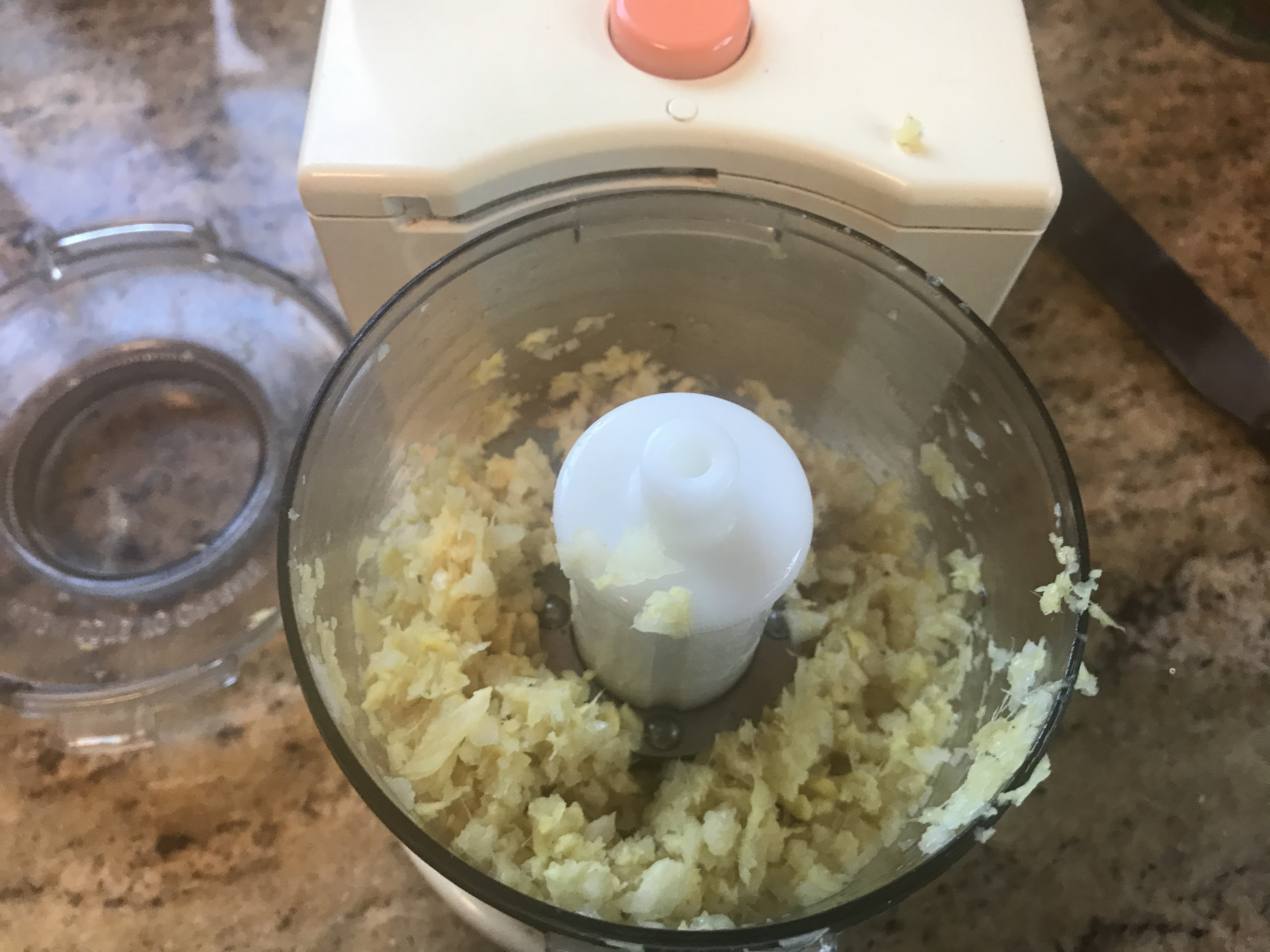
Chop the following in a small food processor, very fine:

1-2 inches fresh ginger, peeled (more if you really, really like ginger)
5-10 garlic cloves (never enough)

undefined

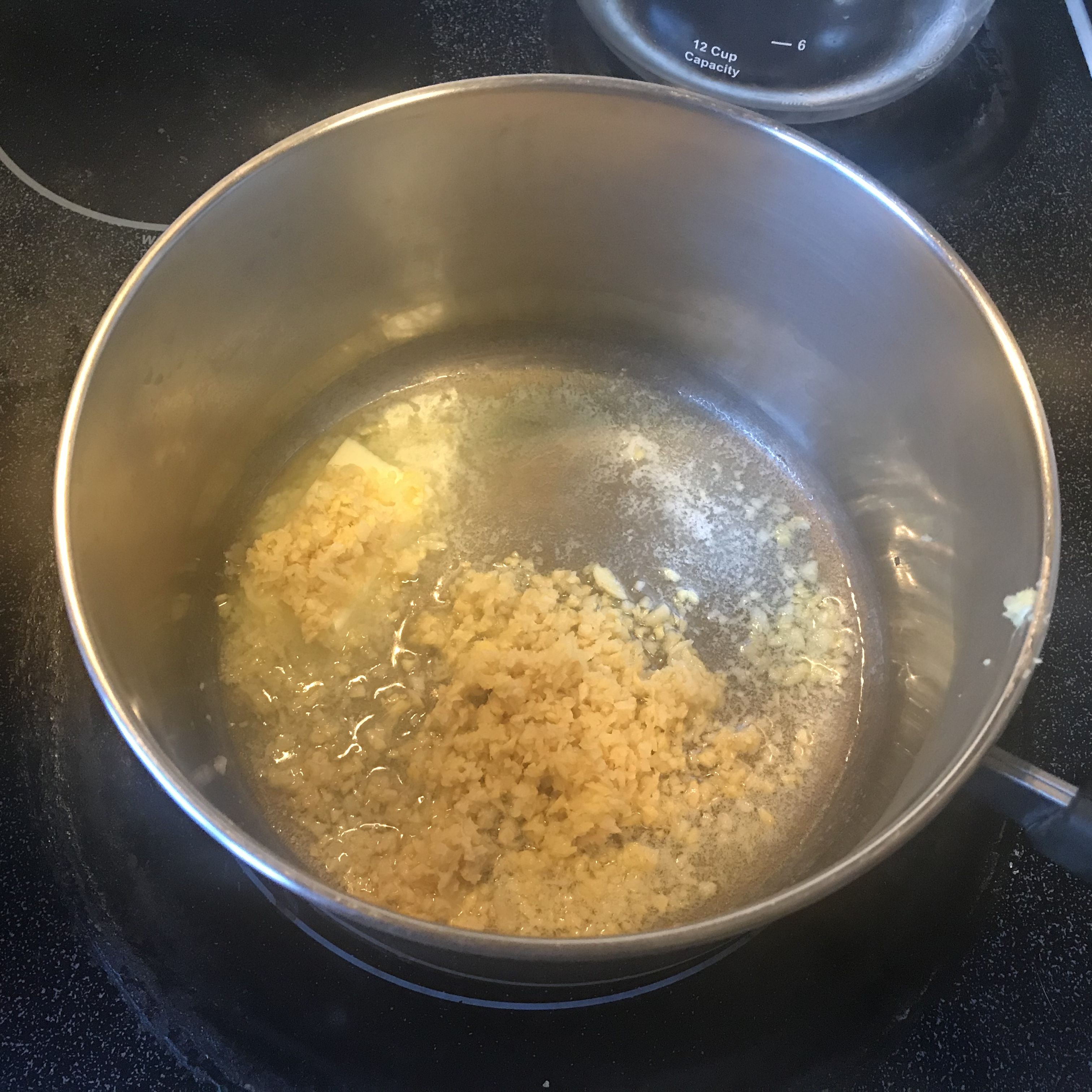
Heat in a large pot (4 qts) ¼ cup of one of the following:
Butter or olive oil or bacon grease (I prefer butter, but I would eat butter by the spoonful if allowed, so consider that.)

undefined
Sauté the ginger and garlic till soft and fragrant, about 5 minutes. Don’t burn, otherwise you’ll have to toss it and start over. Seriously – it’s not worth it to spoil this with burned garlic.

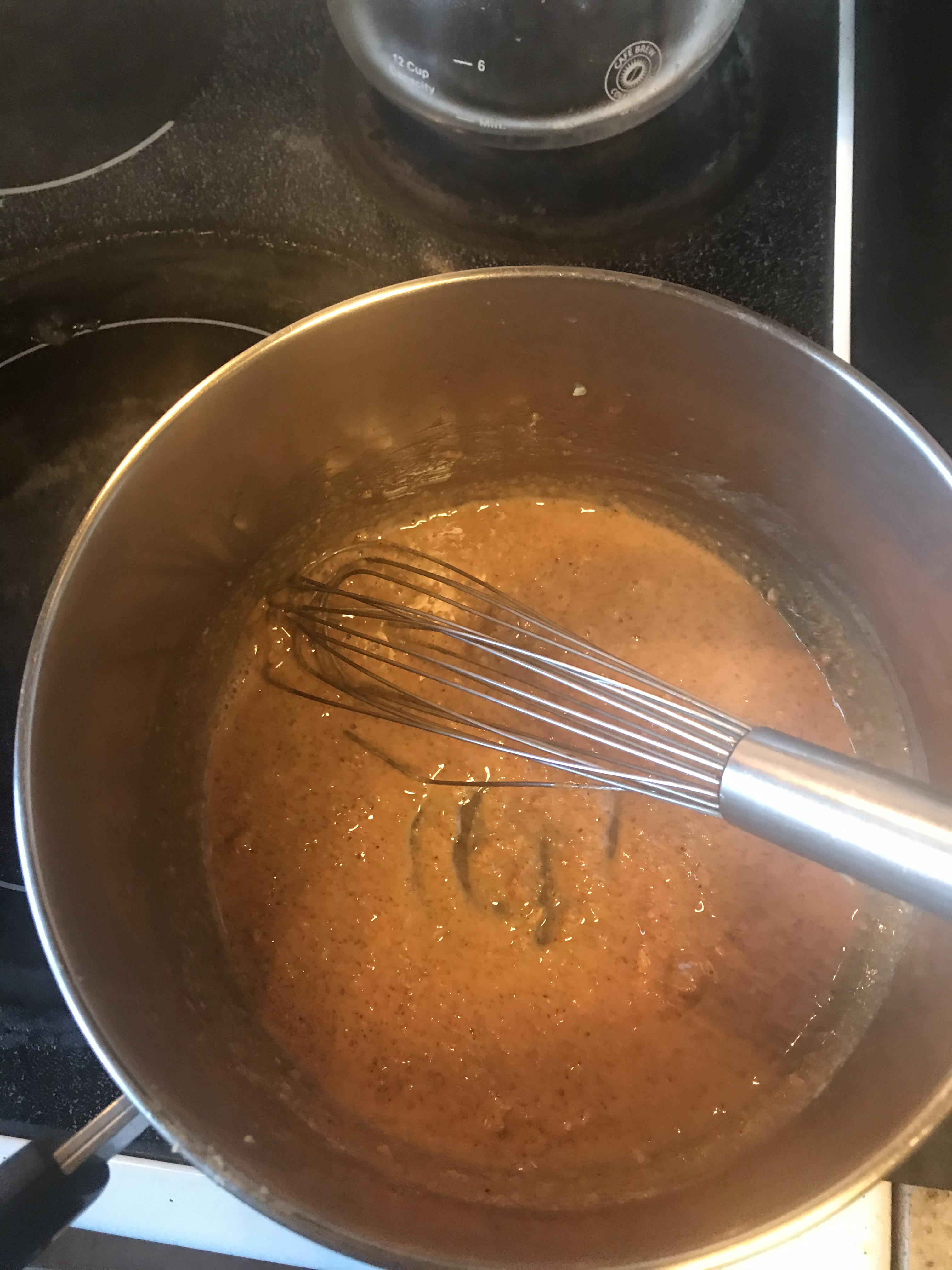
Whisk in ¼ cup almond butter until melted and smooth with the garlic-ginger sauté.
undefined undefined undefined
Dump in:
4-5 cups cooked butternut squash
1 can coconut milk
1-2 cans chicken broth

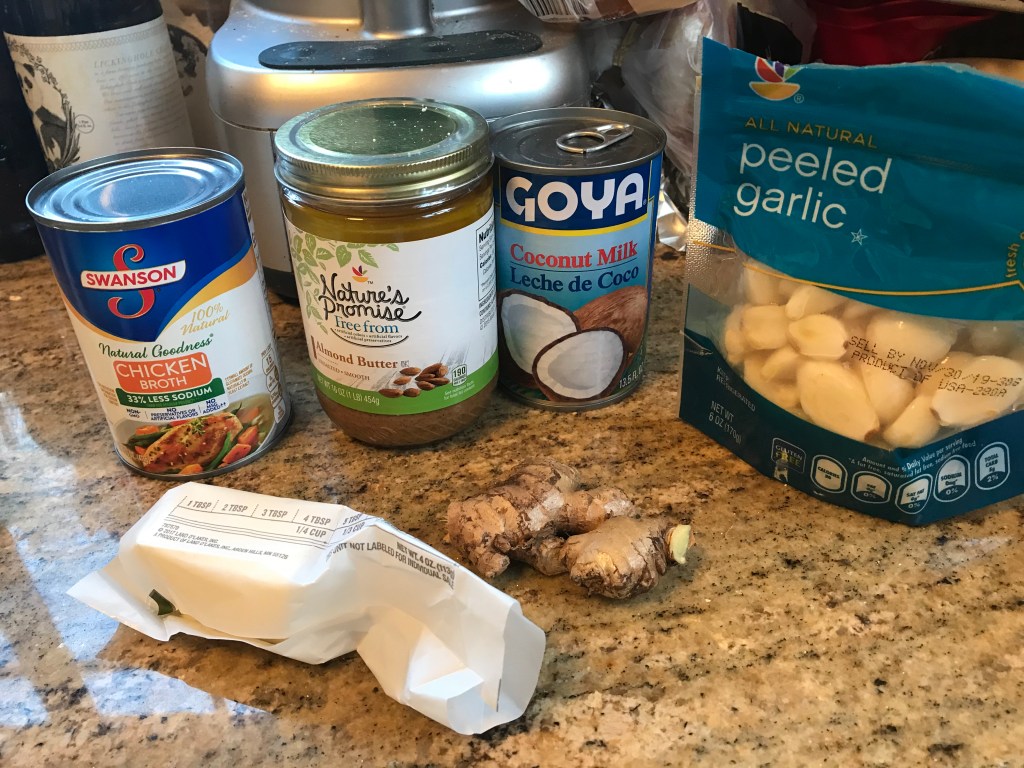
Some of my preferred ingredients

The amount of broth you pour in is flexible. If you barely have 4 cups of squash, then 1 can of broth may be enough. If you have a solid 5 cups of squash that you had to mash down to fit in your 4 cup measuring cup and don’t want your soup to be a pudding-like consistency, please add the second can.

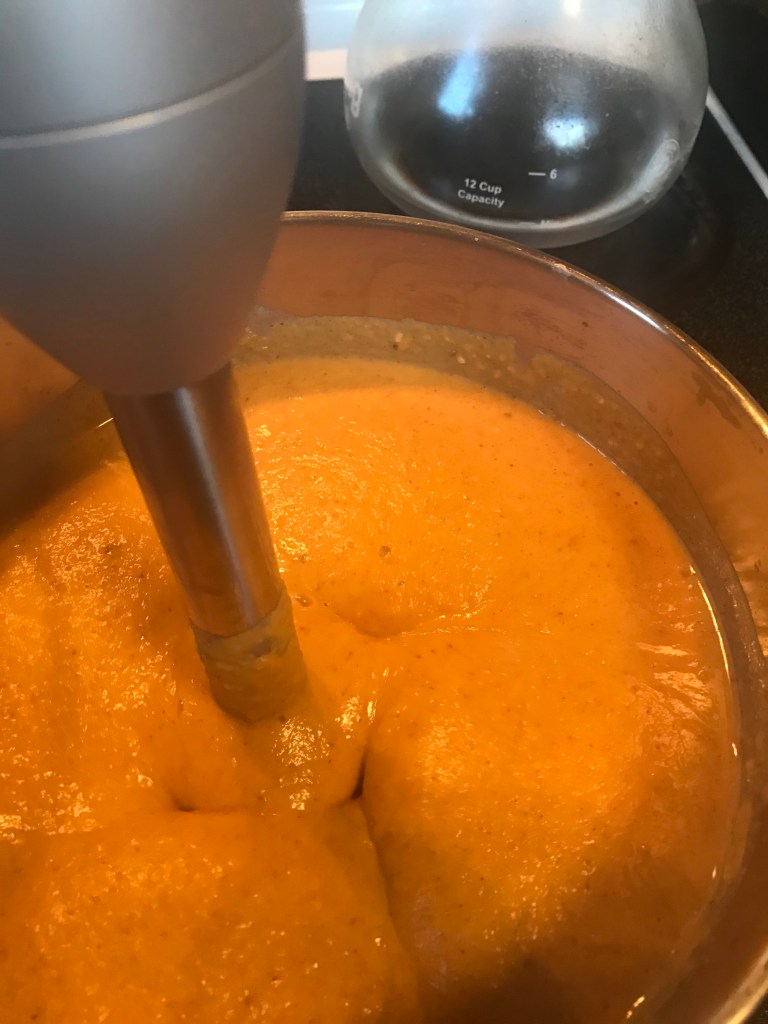
Stir together but at this point you’re really ready for the immersion blender. Like this one. Be sure you position the cord so it doesn’t cross the burner on the stove. You might want to remove from the burner to a safer location, blend it until smooth, and then return to the heat.

Let me say this about my direction to blend until smooth. If it’s not smooth, put the immersion blender back in and blend until it’s completely smooth and there are no lumps. You’ve done all this work and now is not the time to not pay attention to mouth feel. I don’t care how hungry you are to eat this, blend until smooth. You’ll thank me later for stressing this.

Blend until smooth. Really smooth. Lose yourself in the creamy smoothness. OK don’t fall in.

When smooth, heat gently (Careful this soup can bubble up like a pool of lava and burn you when you least expect it. I have the scars.) and consider your seasoning. Here are some suggestions:

Smoked paprika (This is really delicious)

Nutmeg (of course)

Penzey’s pepper and salt (Why are you using any other brand? Go here and order some.)

White pepper (If you don’t have Penzey’s pepper. Use this because you don’t want to see the pepper, just taste it lightly.)

Garlic powder (In case it’s still not garlicky enough for your taste)

Thyme (This was a revelation. Try a dash or two of this – you won’t believe what a good idea this is.)

Cayenne pepper (To each his own, but if you’re just trying this, tread lightly.)

Hot sauce (Some people…)

This recipe makes more than two quarts of soup. You can probably conveniently serve two bowls of soup as soon as it’s ready and then store the two quarts in the fridge. Keeps well for about a week. I’ve never frozen it, it just doesn’t last long enough. Pair this with a ham sandwich and a light beer or glass of white wine. Or if you’re really sick, a good cup of tea.

A note:  I’ve probably adapted this recipe from several sources, but I honestly don’t remember where I found the original. I’ve experimented with it over time. The original probably included cream but since I’m sharing meals with folks who aspire to a paleo diet I put in the coconut milk. Also, I’m Thai food deprived ALL the time so I tried the ginger and the coconut milk to give it a Thai flavor. I’m a fan of the Washington Post column, Voraciously, and I’ve clicked on every recipe site that’s ever popped up on Facebook, so if you recognize this recipe and think I’m not giving proper attribution, just know that I would give it attribution if I knew where it came from.

The Decommissioning

“Though nothing can bring back the hour of splendor in the grass, glory in the flower.”

William Wordsworth

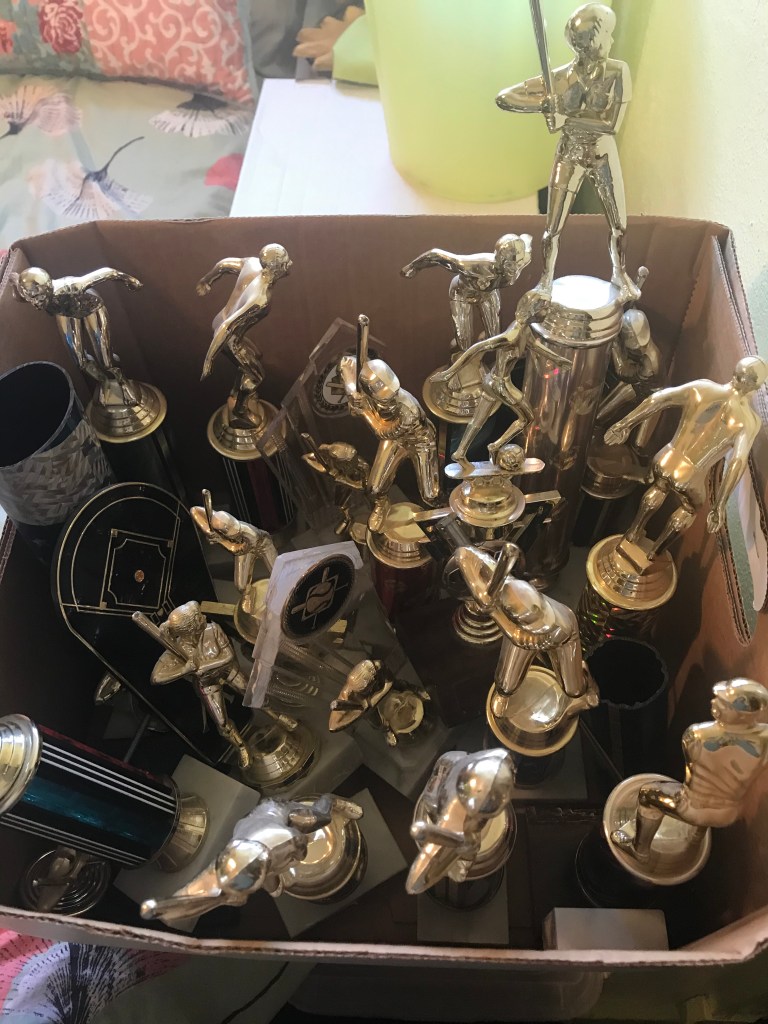
Sometimes we come face to face with our mortality. That all things will end. That the page must be turned. That the chapter ends. And that the sports trophies must go. Children who’ve long relinquished a claim to the bedrooms of their youth have made a life for themselves, and, at a minimum have created new bedrooms in their adult image. No more tiki hut and artist’s studio and posters for The Matrix and Lord of the Rings.

What remains behind are the plaques, the ribbons … the trophies. The trophies, dusty, tarnished, proclaiming mostly insignificant events, not even victories in most cases, but merely the fact of showing up for practice and contests – in the spring from March – June, but also in the fall season, August – November. Of course, when I think about it, summer swim team runs from May – July. I suppose, parents with children in ice hockey and basketball have to deal with a November – March season. And it’s my impression that soccer is ALL year long.

Trophies displayed on the shelf have too much of a physical presence, requiring a footprint that I’m now unwilling to grant.  And yet they remain as an affirmation of a parental commitment to get a child to practice and to the game on time. What I call that portion of child-rearing, the child-relocation business.

Trophies call up memories of the tight turnaround met between the end of the school day and the practice time on the other side of the county. What mother hasn’t pushed the edge of the speeding envelope so that her child wouldn’t have to run laps as punishment for a late arrival.  (A Novel Idea:  Why punish the kid?  Make the Moms/Dads do the laps.)

Trophies represent memories in some cases of games won and lost, but more than not, the moments that one’s child overcame deficits of height or speed, or fell short in skill and power. My breath gets short, my heart flutters, when I suddenly call up a moment of disaster and disappointment that my child felt and endured. A terrible moment of pain that I felt equally, a moment that I had no power to contain, fix, ameliorate, deny, or, just plain, make vanish.

Everyone who even contemplates parenting a child should get some kind of training in learning to deal with failure.  Why didn’t we learn that lesson when we were young? It’s easy to say, ah me, I wasn’t an athlete so how would I get this lesson.

Authorial aside:  A wicked little voice whispers, yeah sure. You had this lesson, it just didn’t stick. Remember when you were a nerd before nerds were cool? Remember the science club election? You lost the presidency to the popular kid who hardly attended meetings? Your boyfriend had to drive you all the way out to Fairview while you screamed out your rage in hot tears at the injustice, the unfairness, the denial of your dream. No matter that the dream was born of a hubris that would make the gods blush – that achievement was supposed to be yours. The loss cast a pall over the remainder of your high school career. Nothing else could erase your anger at being thwarted in your goal. And you never got over it. The sting didn’t subside into an annoying pang until…when? Forty years after?

Winning is so easy – we smile, we laugh, we cheer, we rejoice, we get ice cream, we get pizza, we go to Disney World.  But what to do when we fall short.  How do we help our child when they fall short? How do we deal with the anger, the tears, the sullen silence, the staring out the car window? Our hearts are breaking and the soft cocoon we’ve tried to form around our nascent butterfly has been breached.

What we do, unfortunately, is we try to make winning less important. We try to make the fact that you showed up with perfect attendance be the standard. And we give everyone a trophy. And aside from the fact that these items collect dust, is this such a good idea?

Let’s face it – the trophies are for parents. For that perfect photo op. For the moment when your child is a winner.  Once children figure out that everyone is getting a trophy and that this is the norm and not the exception, the trophy becomes devalued in their eyes. For this to be a coveted treasure it must be a unique, special, and discrete representation of the moment. Which it is not.

And now, years later, the evidence that Mom and Dad did their utmost to give their child a well-rounded experiential youth must be dealt with because these dust-gatherers are living rent free in spaces that would be better used to display the Central American pottery collection.

So, sadly I pulled them off the shelves and examined each of them and remembered afternoons when the sun was falling at just that level on the horizon to trigger a migraine as I was driving toward the west to get someone to softball practice. Recalled the discovery of a fortuitous shortcut that shaved minutes off the trip to gymnastics. Smiled with pride thinking of the reception of brownies baked to feed the swimmers in the car after practice.  And, in a self-congratulatory, valedictory farewell thought of all the hours spent watching, cheering, and managing the t-ball and softball teams.

These are my trophies too.

To actually decommission these objects, I carefully pried the nameplates off with a steak knife, only once stabbing my hand in the process. The nameplates now nestle in the photo album next to that year’s team sports photo.  Two trophies were special enough that I determined a way to downsize them by removing the ostentatious center support and reattaching the figure at the top to the marble base, but those were unique and special, as they should be.

The plaques are another matter.  Plaques apparently are the unique, special, and discrete representation of a glorious moment in time which doesn’t occur until high school and beyond. Plaques will be relegated to a box someday, but they may never be relinquished to the ash heap of history. That Sportswoman of the Year plaque? That Louis B. Armstrong Jazz Band Performer of the Year plaque? Those were triumphs of skill, perseverance, practice, and will.

Those achievements are theirs alone.

“We will grieve not, rather find strength in what remains behind.”

William Wordsworth

For the love of cookies

Cookies.

Cookies are one of the economical delights of the culinary world.  For the same amount of effort it takes to create a pie or a cake with frosting, one can produce a great quantity of deliciousness without a huge expenditure of ingredients or time.

Every year during the holiday season the Washington Post, in an effort to break us out of our chocolate chip cookie rut, publishes a variety of cookie recipes, perfect for sharing, and in my case, for producing a variety of holiday dessert placeholders. As in “what’s for dessert?” Answer: “Have a cookie.”

This year I tried three new recipes, two from the Washington Post and one from the New York Times. The NYT cookie was the Bacon Fat Ginger Snap. This was the least favorite cookie produced. The cookies did not spread out on the pan to produce a crisp cookie, but were rather fat and chewy and would have been well received if the taste had been more than just ordinary. Ah me.

The Butter Brickle Cookies were yummy and easy and produced a LOT of cookies. Their appearance was plainly disarming, but when popped in the mouth the impulse to have a second one was overwhelming. Frequently, a third cookie was required just to confirm their true greatness. This is a recipe that will go into the LOT OF COOKIES section of the cookie binder. (Yes, I have a binder of cookie recipes – don’t you? Why not?)

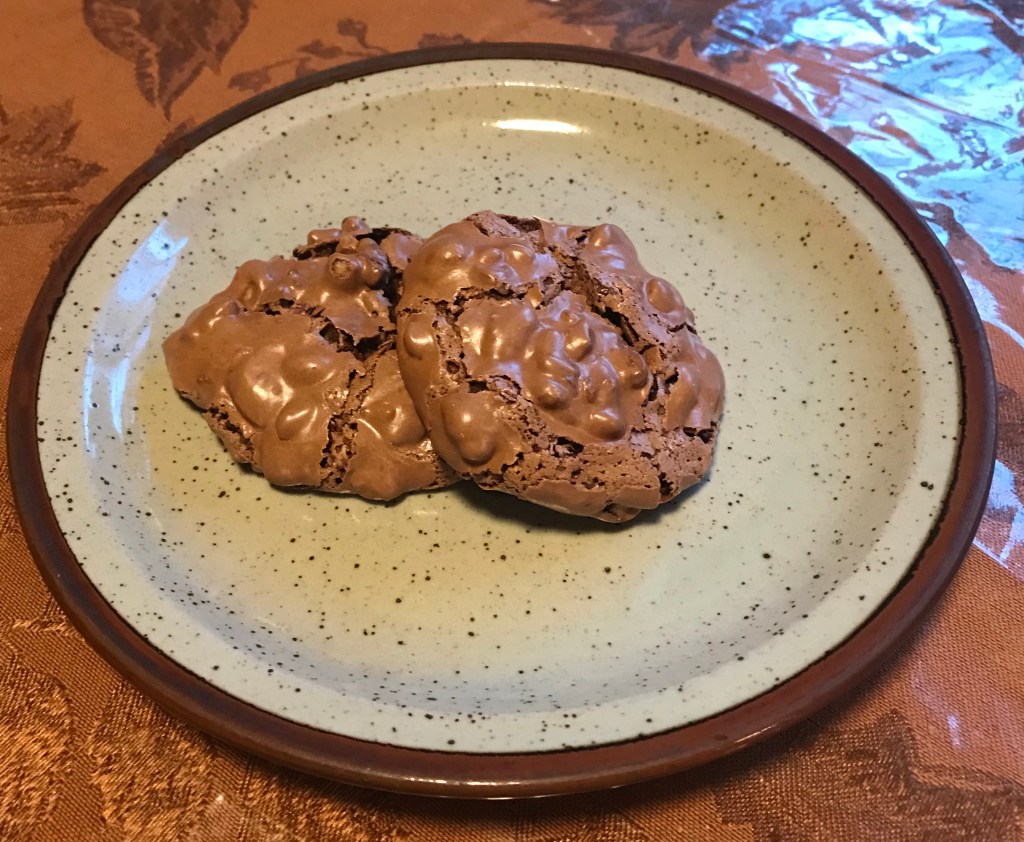
Finally, the most interesting, intriguing cookie was…the Forgotten Chocolate Cookie.  This is a meringue cookie found in Jewish delis and beloved by the author.  The ingredients are very few – egg whites, cocoa powder, flour, vanilla, powdered sugar, walnuts.  Any moderately stocked pantry has most of these ingredients and you can easily run out and get the walnuts.  You can whip this up in minutes and the recipe produces 30 cookies consistently. I know because I made them five times between December 1 and January 15. Here’s why.

The first batch did not turn out exactly right. I used a little too much powdered sugar, but even with that failing it was pretty obvious that a fourth egg white was needed. The cookies were a little too dense but had a good flavor and were somewhat chewy in the center. This was intriguing. Further exploration was needed.

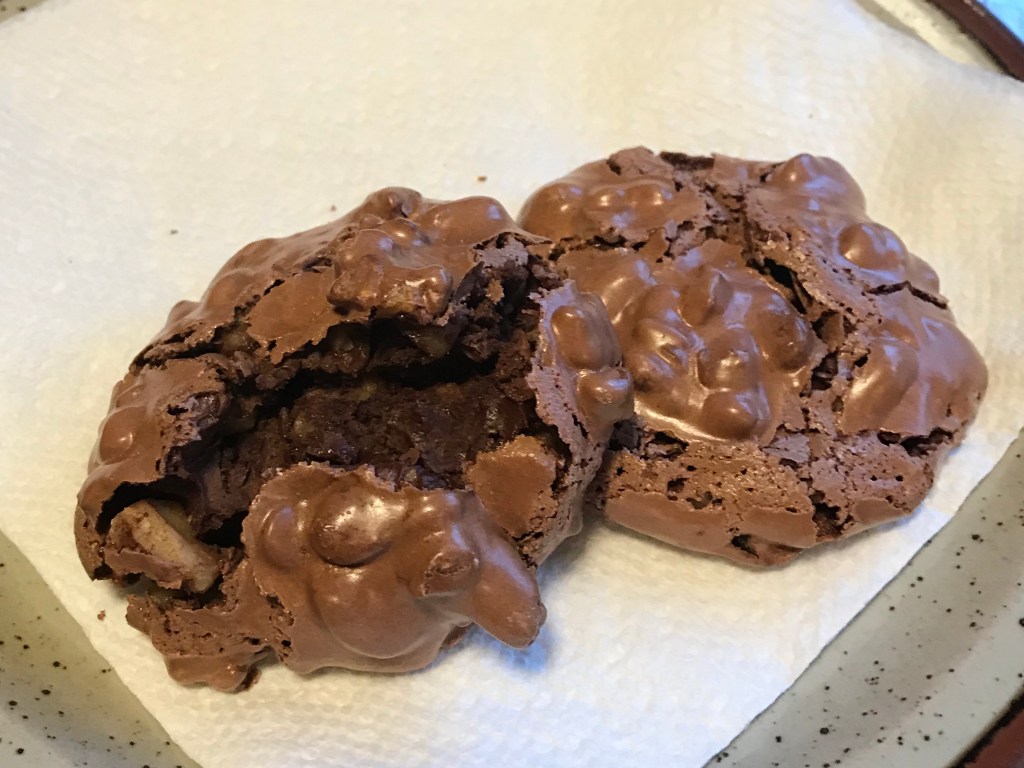
The second batch with the fourth egg white added were absolutely divine. Glossy chocolate cookies, a half inch thick, with a crisp bite and then a chewy center with walnuts. They were like a really elegant brownie.  As foodie daughter described it, the flavor was marvelous but it was more about the mouth feel. No kidding. Biting into one of these was a distinct pleasure.

See the lovely brownie-like center?

Of course, I had to try to guild the lily. Could these be made rum-flavored?  Made a third batch with a tablespoon of rum. No, they could not be made rum-flavored and the vanilla flavoring was missed.

Fourth batch. This was the worst batch of cookies ever. In a misbegotten effort to turn these delightful cookies into something like a turtle (you know that chocolate covered caramel pecan delight) I substituted caramel bits instead of walnuts. Well while the caramel did melt, it didn’t melt into a sticky filling. With each successive mastication the cookie formed an ever-sturdier glob in one’s mouth. The glob wasn’t so solid that it couldn’t ultimately be chewed and swallowed, but it did constitute something of a choking hazard. This batch was nothing short of unpleasant. Mouth feel was out the window. Cookies went in the trash. I really can’t stress how awful they were.

To wash the taste of that terrible experiment out of my mouth and mind, I made a fifth batch for a group of friends who came over for lunch. Everyone loved them. Everyone asked for the recipe. Everyone except for the one person who had already saved the Washington Post cookie section.

Click here to get to the Washington Post recipe for the Forgotten Chocolate Cookie, forgotten no more and universally loved. Click here for the Butter Brickle Cookie which is pretty darn delicious.

No link will be provided for the NYT Bacon Fat Ginger Snap cookie. That needs more research and development. But I’m optimistic.

January 2020

A Capricorn’s Adventure

There’s an egg here somewhere.

So I’m ambling through the grocery store with my cart and my stuff and I’m at the front aisle where the magazines and tabloids are displayed and a tall gentleman there at the display area suddenly turns to me and in what sounds to my untraveled suburban ears Jamaican-accented English says, “What this means – kicks off?”  He’s rather urgent in his question and I’m startled and don’t immediately understand what or why he’s asking me and I say “What?” And he points to the section of the tabloid he’s holding and it’s the Astrology column. He points to the Capricorn listing which begins, “March kicks off…”. Oh.  I see.  “Begins. It means begins or starts off.”  I smile. He eagerly says thank you several times.

Oh I wish I could make everyone that happy.  Or at least bring clarity to their lives.  Should I change jobs?  What does this sign mean?  Where should I go?  What should I do?

Right now, I would like clarity on two issues:

Who to select as our natural gas provider?  Dominion Power, WGL, NOVEC, etc. Apparently WGL still delivers the gas in the pipe to our house but how and who we buy it from can be different. We can get it from a variety of purveyors who promise us savings.  Great savings.  But I’m suspicious.  I don’t believe any of these entities has my best interest at heart. They are in business to make money and I get that but I don’t want to make a mistake.  Meh.

The other issue I need clarity on is whether to add Medicare Part B to my health insurance portfolio. I already have BC/BS but I got a flyer in the mail from BC/BS touting the benefits of adding Medicare Part B…. Double meh. Again I don’t want to make a mistake.

I am a Gemini. I can argue both sides of an issue. I can argue all day long. This is my favorite participatory sport.

I can weigh the benefits of an issue as well as any Virgo. I can impulsively choose and choose wrong or right as well as any Aquarius. I can forthrightly state a position and stubbornly (Taurus) and enthusiastically (Sagittarius) lead (Leo) or even strongarm (Scorpio / Aries / Capricorn) a group into an action. I don’t cry much about stuff but I do grieve silently (Cancer) over sins of omission. What I lack is balance (Libra). I can worry an issue for months without a resolving action which is infuriating. It means that item on the list is never crossed off. It’s always pending. The paper references can’t be tossed until a determination has been made. And the cost of making a mistake will mean that I will be paying more for something for which I could pay less.  If I pay more there will be an opportunity cost – that is to say, there will be something that I can’t have or do because the funds have already been allocated elsewhere.

Where is that kind person who will answer my “What this means?”

First world problems. Yeah that’s right but not even cool first world problems. Old people problems. How boring.

December 2019

The Oyster in the Turkey

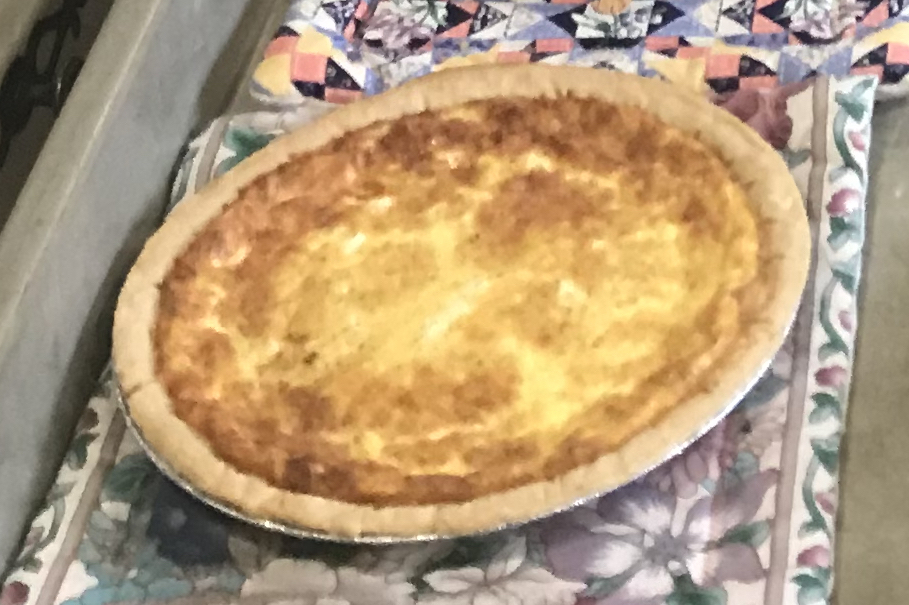
Swiss Cheese Pie – traditionally served at Holiday Shop,
Mt. Vernon Unitarian-Universalist Church, Alexandria, Virginia

Author’s Note: This post was presented as a homily on December 1, 2019 at Mt. Vernon Unitarian-Universalist Church, Alexandria, Virginia as part of a lay-led after-Thanksgiving service entitled “Butter the Size of an Egg.” Through stories and readings, the service describes how the holidays are a time of tradition and food, a time that stretches back to bind us spiritually to ancestors and family. One of three homilies, this one is reprinted here.

__________________________________________

Tradition is peer pressure from dead people.

The Internet – author anonymous

America’s great secular tradition is Thanksgiving. A secular tradition based primarily on being grateful for having a full plate and full belly. A tradition based on eating the same 15 things your parents and their parents and their parents ate every year at this time.

How many of you ate turkey? Tofurkey? Green bean casserole?  Sweet potatoes with marshmallows?  Cranberry dressing or chutney or jello?  Pie?  Added in something that might not be traditional but really, why not?  Cause it will make Rachel’s boyfriend/Sam’s girlfriend / Joe’s cousin’s ex-wife / soooo happy!!

How many of you gathered with family?  Gathered with friends? Had some kind of a crowd of people around you? How many of you watched a parade?  Watched football?  Played football?  Ran a 5K?  Fell asleep in your dessert?

A story:  And it came to pass in the West Texas town of El Paso that the wife of a man with no family of his own was killed in a terrible event.  And having no one to grieve with him, for his wife was a good and kind woman whom he had loved all his days, the man asked everyone in the town to come and grieve with him at his wife’s funeral service.  And lo the multitudes did hear and attend him in his grief, bringing flowers to remember the good woman, embracing the man and saying to him, We Are Your Family. You shall not grieve alone.

That’s a true story.  I’ve tried to recast it as a Bible story because how else to tell stories like this but as a mythic object lesson for the rest of us to learn from. How else to hear a story like this in the aftermath of the El Paso Walmart gun violence some months ago. An unbearable story unless you hear the parts about the goodness and courage of people rising above the horror and offering comfort to each other.

It is a story that reminds us that we are all bound together in the human condition – which when I asked what that was, the professor explained to me that we are all mortal and that we would all die. And because of this, because we are bound together in the human condition we have devised rituals to celebrate our shared mortality. Rituals and traditions that we cherish, that we resist, that we grudgingly perform for the life events common to us all.  Birth.  Marriage.  A coming of age.  Celebrations of thanksgiving, of rescue, of salvation, and of resurrection – all of these are reflective of the human condition.  And all of these common events are frequently tied together by family and food.

And since in all likelihood most of you have just celebrated Thanksgiving.  So I ask – How many of you heard the words “it won’t be Thanksgiving if we don’t have…fill in the blank.”    Whether that be a person  — Aunt Jane who drinks a little too much or a special dessert – Cousin Jim’s peanut butter pie with cornflake topping – traditions tie us to the past and give us comfort that things will always be the same. That we will always be loved and cherished with those we know. That the peanut butter pie will always taste… awful. That Aunt Jane will always have to be driven home by her nephew Pete who doesn’t drink. At all.

Tradition is nothing more than quality control for the future.

Running through all of this tradition are words of faith.  Many of you may have said grace and been fine with that.  Many of you may have bowed to a grace that did not reflect your faith or beliefs. Many of you may have grumbled under your breath during the saying of said grace.  My brother used to give me the side eye to make me respect the grace offered by my brother-in-law. But like me, you bowed your head and endured because that’s what we do for family.  For as it says in Ecclesiastes – there’s a time to fight and there’s a time to refrain from fighting.   So for the sake of peace, Sandy don’t talk about the news because Uncle Frank is a Trump supporter and Aunt Fran is a Bernie Sanders socialist and we’ll never get to have dessert.

How many of you had just one dessert on the table?  Two desserts?  Three?  How many of you just ate dessert?

When I was in my early twenties and newly married, it became tradition after Christmas dinner that my father-in-law, Bill, and I would clear the table and package up the leftovers. I would wash dishes and he would salvage the leftover turkey for the sandwiches to come. On one such occasion, he mentioned to me that he and Sue (my mother-in-law) loved me as if I were their own daughter.  Which is a touching thought even though I’m not sure Sue would have agreed.  However, I was really the only daughter of any kind they were ever going to have at that point, my husband being an only child.  Sue was a woman I admired and whose approval I desired.  But the affection from such a decent, kind human being that my father-in-law was, that was a real treasure, especially offered to the rude callous careless twenty-something that I was. On another occasion as he was stripping the turkey carcass, he offered me the tender piece of dark meat from the back of the turkey and said, “here have the oyster.”  Bet you didn’t know the turkey has an oyster, two as matter of fact, in the hollow of its back?  I certainly didn’t know that, but I accepted the scrap of meat and it was delicious. I never pull the meat from a chicken or fowl without finding the “oyster” and thinking of Bill, without remembering that special moment in time.

The words of the faith we grew up in cling to us like pet hair. Whether we retain that faith or have grown and moved on to other beliefs or no beliefs, the words still come to mind on occasion don’t they?  After years of resistance I’ve finally come to accept their attachment to me. “I am a part of all that I have met,” says the poet.  Well that’s the hell for sure.  A beautiful day always calls to mind for me the words “This is the day the lord has made.”  I don’t believe in anything like a supernatural creation story, but those words are comforting to me in a way that has nothing to do with religion and everything to do with a remembrance of a time when life was so much simpler. It may have been simpler because of my ignorance of the world but it was simpler. Another phrase: “I was glad when they said unto me, let us go into the house of the lord” comes to mind frequently on ingathering Sunday. Ingathering Sunday – that delightful compilation of salads and desserts that accompany hot dogs, hamburgers and grilled chicken. Early Thanksgiving. Angel Collins’ Banana pudding –  that’s what I call a sacrament.  You know that old joke: the kids were asked to bring in symbols of their religious affiliation. The Catholic child brings in a rosary, the Jewish child brings in a prayer shawl, the Unitarian child brings in a casserole dish.

So don’t resist your upbringing, don’t resist tradition.  Accept it. Adapt it.  Remember it, if only not to repeat the mistakes, and create new ones.  New traditions, not new mistakes.

Be gentle with your family and friends.  Life is too short to fight over what kind of pie to serve. Serve both. Or three. And add a fourth just to be safe. And a cake. Have the tofurkey and the turkey and the turducken.

Mumbling to yourself and wish you’d had this lesson before Thanksgiving?

Don’t worry – Solstice is coming. Christmas is coming. And Hanukkah. And Kwanzaa.  And the Feast of the Three Kings.  And Festivus, don’t forget Festivus.

November 2019

Lost Youth

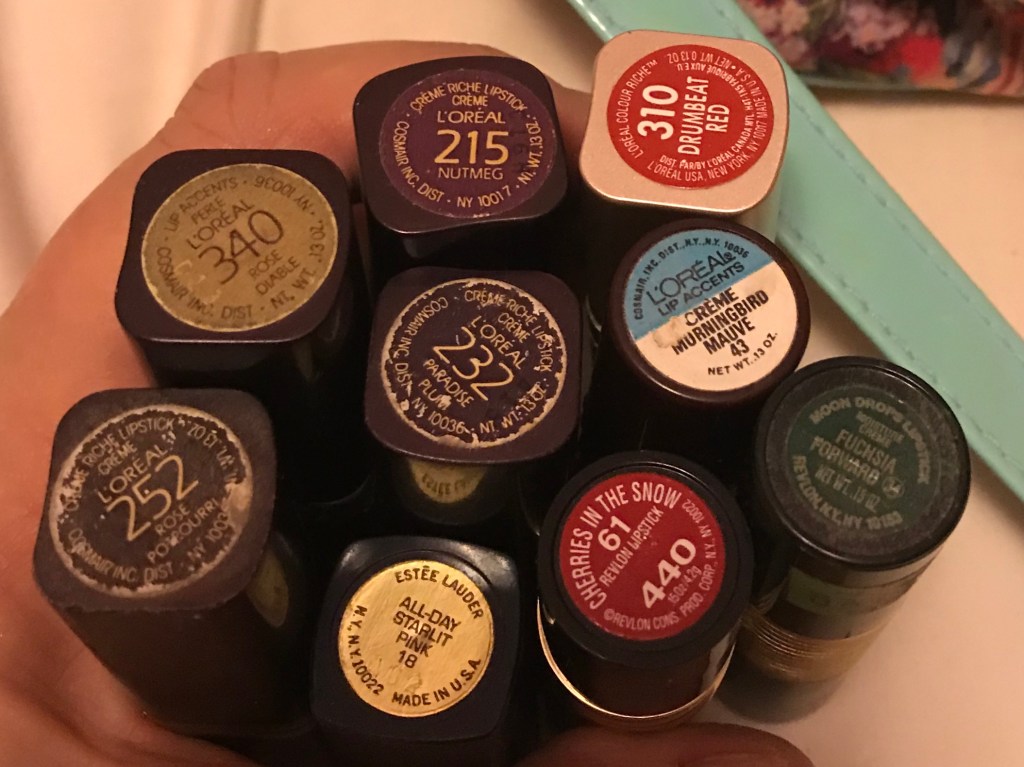
Lipsticks, circa 1975 – 2000

I can be extremely sentimental over stuff.  Stuff here is defined as a flotsam and jetsam of paper, artifacts, souvenirs, found objects, notes, etc. 

My method of dealing with the paper is to put it in sheet protectors in binders. This way it’s at least in a form that can be easily admired, re-read, and reminisced over.  It’s better than a box. BUT – I’m up to four regular binders and two solely for Girl Scout stuff. I’m working on filling a binder of the first year of retirement and then there’s another binder in which I’m gathering more found stuff.

I’m sentimental about certain articles of clothing. There’s a Lands End jacket in the back of my closet which I can’t possibly zip closed or even wear open in a dignified manner. It has a beautiful soft plaid lining but it’s best feature is the soft forest-green Teflon-coated outer fabric. I love this coat because it was my go-to Girl Scout coat for so many camping trips, both with the family and with Girl Scouts. If I look thru my camping photos – there’s that coat.  How can I give up my old friend? When I think about giving it away I think of Colline in La Boheme, singing goodbye to his coat which he is selling to buy medicine for Mimi. I saw Samuel Ramey in that part on a PBS broadcast of Live from the Met. Ramey is an incredible bass with such acting ability that I cried at this part of the production. Heckuva thing – he’s saying goodbye to his coat and I’m crying.

So all this is preamble to the main reason for this post:   I went through my collection of eye makeup and lipsticks which I haven’t worn in years (20?) and tossed all of it. Well almost all of it.

But before it went in the trash I looked at them and reminisced.  Pretty sure I buy things not just because the color suits me but because of the name:  Morningbird Mauve.  Cherries in the Snow.  Drumbeat Red.  Rose Diable.  Paradise Plum.  All-Day Starlit Pink.  Nutmeg.  Fuchsia Forward.  Amethyst Sea.  Misty Lilac.  Blue Moon.  Alabaster and Onyx.  Cosmic Copper.  Graffiti Splatter – Bronze / Marine Aurore Chicoree.  Moonlit Jewels. Desert Sky.  Purple Sage. sigh

All of these held promise for an imaginary exotic me who never existed except in my own mind. I’m just not the makeup-wearing type.  I did make the effort when I managed my own business and later on in partnership as a graphics design executive. But after the age of fifty, it just seemed too much trouble except for a really dressed-up state occasion. After sixty, it was way too much trouble except for my daughter’s wedding.  With age, eyelids start to develop folds so that even if you applied eye makeup, it wouldn’t be visible anyway.

Lipstick just seems too much trying for a long-lost youth and frankly can look clownish on ladies of a certain age.

My favorite brands were L’Oreal and Estee Lauder but there’s a smattering of Revlon also. Revlon developed a series of cases in which you could pop in replacement colors. That was fun – just plug in a new bronze, cream, taupe, or blue color and voila – new look, new you. I have kept four Estee Lauder lipsticks because they were just too all-purpose and you never know – I might do something exotic which requires more than an I-don’t-care look.  I kept a Revlon case of brown and cream. But everything else went in the trash.

Well not the Drumbeat Red.  That just looked too useful.  I might need it to write revolutionary slogans on a bathroom wall.

You never know.

November 2019